Nov 26, 2006

India's Armed Forces: Ready for the Future?

Nitin points out that motivational levels in the Indian armed forces could fall if compulsory military service for every Indian is brought in. He is of the view that an army that is smaller, well-trained and highly motivated will be far effective than a huge mass of reluctant people forced to serve.

In this regard the Indian army’s GI Joe plan is worth noting.


The Indian Army wants to turn its soldiers into superheroes…

It has embarked on Project F-INSAS (Future Infantry Soldier as a System), which visualises the Indian soldier as the ultimate terminator — one with unprecedented lethality, mobility and survival skills.
Project F-INSAS will exploit advanced technologies to enhance the capabilities of individual soldiers, making them "multi-mission, multi-role war fighters".

[…]

The supersoldier will be equipped to fight by day and night, in all conditions and terrain. Modular weapon systems that can be re-configured - allowing an assault rifle, for instance, to be turned into a light machine gun - will equip them to meet changing mission requirements. Integrated sight systems will have thermal imagers, invisible laser aim pointers and a red dot sight.
…F-INSAS intends to make the Indian soldier a self-contained fighting machine. By 2012, the Army will field the first version of F-INSAS, based on available technology….

The supersoldier will sport some incredible accessories. Smart vests, for instance, will come with sensors to monitor vital signs like ECG, body temperature and heartbeat, and will allow pinpointing bullet injuries.

Sensors in the vest will provide online information to doctors about vital body signs. Combat helmets equipped with head-up display will provide a field of view equivalent to a 17-inch computer monitor right in front of the soldier's eyes.

Output from the soldier's personal computer - attached to his backpack frame - and other sensors will be shown on the display unit, which will be the interface with the other subsystems and the digital battlefield.

A futuristic radio subsystem will enable the soldier to transmit and receive voice messages and data, including streaming video. He will also get specially made boots to give some protection from landmines.[HT]

The Indian armed forces should not lag behind in adopting the latest military tactics and technologies that can minimise ones own casualties and inflict maximum damage on the enemy.

Right now technology is being used to fight urban terror attacks in Jammu and Kashmir and this is a welcome development.


The Indian army has digitally mapped both Srinagar and Jammu, installed secret high-resolution cameras at 32 vulnerable public places, and wired police squads with Global Positioning System (GPS) devices in both the cities.
With this new gadget will, among other advantages, enable the police to sit in Jammu and watch live on computer screens the goings-on hundreds of kilometers away in Srinagar or vice versa. This means converting a normal police control room into a command centre.
This new initiative will also help police identify suspects and increase transparency. Camera images will, for example, help establish the truth in cases where the police are accused of excesses in dealing with public protests.

When a militant attack is reported in any part of the two cities, the calls to the police control room will be answered by a call centre where trained police staff will take down information, trace the location of the nearest police cars and direct them to the site of the attack.

The mobile phones of officers will soon be wired into the GPS-based security grid…

Such systems common in the West are used to tackle crime and traffic violations. In J&K, they will be focused entirely on fighting militant attacks.[HT]

There is a lot of time to develop the futuristic soldier. Right now the Indian armed forces should take immediate steps to address more serious problem of shortfall in the armed forces strength.

In many parts of India the army is the only source of employment for many. In strife torn Jammu Kashmir it is that very despised Indian army the only source of employment for large number of people. This is the same in many other areas of India too. Because of this the infantry quota is always filled up.

It is the officers’ quota that has fallen back. It drastically needs new recruits to fill up the shortfall. The officer shortfall is 11,000 in the army, 5000 in the navy and 500 in the air force. This is serious matter and compulsory service is not the answer because an unmotivated force will be sitting duck for the enemy.

To fill up the shortfall, slickly made ads showcasing the extracurricular activities of the army is not just the answer when today’s youth – in a booming economy - has better options of safe and better paying jobs in other sectors. Apart from offering attractive compensation packages matching the best offered in the private sector, the pitfalls of having officer shortfall should be effectively communicated to young prospective candidates. For this the army should take the help of the best PR talent available. There is no guarantee that this will fill up the shortfall but the motivated ones will surely reduce the shortfall.

Sometime back to boost recruitments from Gujarat which has low levels of representation in the Indian army, the army came up with a weird plan of holding an exhibition in Gujarat where arms and ammunition seized from Islamist militants in JK and elsewhere in India. The timing of this exhibition was interesting – soon after the 2002 Gujarat riots when anti-Muslim, Hindu nationalist feelings were very high in Gujarat. I don’t know what success it had.

What size the Indian army should be is still debatable considering the future state of affairs. The present strength of 1.1 million makes the Indian army the second largest after China’s. A time will come when a strong and rapidly growing India will have to assert itself in the world and may have to sent troops to safeguard its interests in other parts of the world. Sooner or later our troops might see action in Afghanistan where we have vital interests. Just like China our hunt for black gold and other minerals could get nasty and then we will have no option but to call up on our troops to safeguard our interests.

We need a blue water navy to keep an ambitious China in check in the Indian Ocean. That means a Navy with at least three Aircraft carrier flotillas, a first-class submarine fleet plus the regular Naval flotilla.

Coastal security should be strengthened without delay, as there is definite threat to vital costal installations – onshore and offshore – from terrorists.

Another Fiji should not happen anywhere. Nowhere should Indian Diasporas be second-class citizens. In case it becomes inevitable in any part of the world, then the government of the day should not shy away from helping that Indian Diaspora by whatever means to achieve their stated goals.

All these scenarios call for a large armed force that is motivated and raring to go at all times.

Nov 23, 2006

Educating Indian Commies

The Indian Commies got the shock of their lives yesterday when their master from the land of the dragon, the Chinese President Hu Jintao advised them to adopt a "more pragmatic" approach, as this is the era of globalisation that provides immense scope for economic prosperity. In other words the Chinese President was telling the Indian commies exactly what late Deng Xiaoping taught the Chinese long back – to get rich is glorious!

The great master thus pontificated to the utter discomfort of his Indian slaves: “Globalisation provides scope for economic prosperity, and a "more pragmatic and positive approach" must be adopted by the Left to develop infrastructure and the economy”.

Red China had the good fortune to realise in the late 1970s that a socialist economy cannot and will not deliver its vast poor out of hunger and poverty. Red China’s slow and steady opening up of its economy has only been positive for the Chinese people. Now the results are so spectacular that the Chinese university students who once upon a time dreamt of a China free and democratic have today no time for such trivial issues. Their only concern is to get the next big job in the next big MNC setting up shop in China or already waiting for them. Today the Chinese are so confident about their future that that have virtually thrown that dreaded Mao out of their history books and today their history is about their future! The world has not failed to notice this. So much so that today Chinese nannies are increasingly the preferred ones in the West so tomorrow’s white kid is not left behind in a world that will be doing business in Mandarin.

The Indian Commie is not an idiot on the contrary he/she is a person with high intellect. This is why it baffles most of us why the Indian commie is still holding on to an ideology that has been dumped by every other major Communist country on this planet. The answer is because this country still has vast multitudes of utter poor and the Indian Commies have been able to sell some of these people an utopian dream of economic prosperity where all will be treated equal. Thankfully (or for worse) the average Indian values his caste more than anything else and still vote according to caste lines. The Indian Commies have been able to make an impact of any significance only in three states – West Bengal, Kerala, and Tripura. It is only in WB they have been in power continuously for the last thirty years. The major reason attributed for this is the land reforms undertaken by the Commies where land was distributed to the landless poor. Other than this the state of West Bengal under the Commies has no other significant achievements to showcase be it in social or economic fields.

India has been a democracy from its independence and the Indian commies like any other political party have to fight for its share of votes. No party can fight elections without adequate finances.

For the commies trade unions affiliated to them are their major sources of finances. Trade unions basically represent the organised workforce of a country and in India this is a minority when compared to the unorganised sector. The unionised labour force despite being a minority is able to negotiate better pays for themselves because of their collective bargaining power. All that Indian Commies want from these unions is a nice cut from what their collective bargaining power got them so that their retrograde political parties can live another day. They know where the moolah is and exactly because of this they are dead against privatisation and just wouldn’t allow labour reforms, which is so vital for India’s economic well being. Even without any labour reforms India is at 43rd position in the Global Competitive Index far ahead of autocratic China, which is at 54th place. So just imagine in what position would have been India if it had carried out labour reforms and didn’t slow/halt the economic/privatisation process.

Lately the Commies have realised what a cash rich cow the IT sector is and want their cut from this sector too. The only reason the IT sector has become what it is now, a cash rich cow, was because the Indian govt and the trade unions didn’t realise what happened in this sector. The non-interference gave the IT companies space to grow and when the govt realised the potential of this sector during the Y2K days, was wise enough not to interfere but stay out and facilitate its growth. Now the shameless Commies of India are salivating in their mouth dreaming about the moolah they can make out of this sector especially from the call center employees. Without an employee union affiliated to them no way can the Commies get their cut. In order to achieve this they have set up an union and have cajoled some hapless Calcutta based call centers to allow employee to join. I look forward to see how the Commies make moolah out of this sector with high attrition rates.

So it is clear that for their sheer survival the Commies of India are like that only – dead against reforms and privatisation. By the way this doesn’t mean that they are illiterate about capitalism. Just look at what West Bengal CM Buddhadev Bhattacharya is doing. He sometimes put the original dream team to shame.

Now the question is why was the Chinese President able to advise the Indian Commies to become capitalists. With having unlimited wealth because of Western style capitalism seasoned with local characteristics, in an autocratic country with a single party rule, day-to-day survival is not exactly a priority. As the Chinese govt gets out of more and more sectors and their forex reserves stockpiles, all that the Chinese Commies need to do for their survival is to take very good care of its armed forces and its party members on a priority basis. Their original support base of peasants and workers can very well be second priority or can go to hell.

Now we know why the Chinese Commies can afford to ‘advice’ their comrades in democratic countries.

Nov 20, 2006

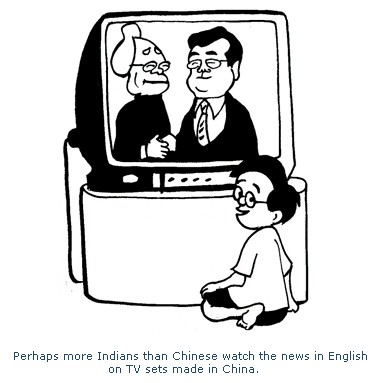
Cartoon Speak: Chinese Reality

Courtesy: Indian Express

Nov 16, 2006

New Cricket Record in Batting

Boddepalli Manoj Kumar (left) and Mohd. Shaibaaz Tumbi (right)
Two awesome 13-year-old Hyderabadi boys have erased the highest batting partnership record that catapulted Sachin Tendulkar and Vinod Kambli into cricketing history. The best thing is that the record is staying in India but just moved next door to Andhra Pradesh from Maharashtra.


Two city [Hyderabad] lads created cricketing history piling up a stupendous 721-run partnership in 40 overs flat for St. Peter's School against St. Phillip's High School in the Hyderabad Cricket Association Inter-School (Under-13) cricket tournament at Parade Grounds on Wednesday.


Triple centuries by openers B. Manoj Kumar (320 not out, 127 balls, 46 x 4) and Md. Shaibaaz Tumbi (324 not out, 116 balls, 57 x 4) saw them race past the previous record of 664 runs scored by Sachin Tendulkar and Vinod Kambli for Shardashram School in Mumbai in 1987-88.

In fact, the boys scored in a single day unlike the famous duo, which took three days for the record partnership. "We feel nice to have broken Sachin and Kambli's record," the tired but jubilant 13-year-old, eighth standard students of the Old Bowenpally school exclaimed. [The Hindu]


More Reports from DNA, Indiatimes.com, Timesnow.tv

Some Memorable Indian Phrases

I stumbled upon this collection of memorable phrases from Indian advertisements and other fields. I am just listing the most memorable of them here. For the complete list please visit the link.

Dhoondhte reh jaaoge: A Surf Ultra ad line that became part of everyday terminology.

Jhakaass: Meaning very cool, was first used by Anil Kapoor in Joshilay (1989).

Kitne aadmi the: Probably the most popular line in Bollywood history, mouthed by the menacing Gabbar Singh in Sholay (1975) to his henchmen. Used indiscriminately in ads and promos.

Dho dala: Clinic All Clear's tagline to erase all traces of dandruff, also refers to wiping out an opponent, as in Dhoni ne dho dala.

Bindaas: A word that means blase, popularised by Stardust, and commonly used in conjunction with 'babe'.

Vaat lag gayi: The tapori phrase used across regions to indicate trouble. Brought into our homes by the affable gangster played by Sanjay Dutt in the unforgettable Munnabhai MBBS (2003).

Lambi race ka ghoda: First used by Davar Seth for Amitabh Bachchan in the 1975 classic, Deewar, the metaphor has stood the test of time.

Yeh dil maange more: The TV coverage of Captain Vikram Batra's use of this phrase during the 1999 Kargil war catapulted the Pepsi tagline into common parlance.

Naani yaad dila denge: Immortalised in Rajiv Gandhi's famous tirade against foreign powers, delivered at a rally at the Delhi Boat Club in 1989.

Bheja paka diya: Effectively expresses discomfort, also appeared in a 1999 india today feature.

Yeh andar ki baat hai: The Rupa underwear ad line that has gone beyond to denote corporate politics, secrecy and even hidden feelings.

Hawa nikal gayi: A 'tyre' specific situation that now stands for deflation of swollen egos.

Item number: Not just the movie staple, it is now stretched to connote the 'highlight' of the show-be it a guest lecture or even a presentation.

We are like this only: The dosa-chomping south Indian cowboy hero of the Channel V promos, Quick Gun Murugan launched himself, and this line into iconic status.

Funde mat jhad/Too much gyan: An excessive and irritating display of knowledge.

JLT: Just like that. University parlance of the 1990s that moved outside campuses.

Puppies: First used in a 1989 India Today feature, it is Delhi's desi contribution to the social lexicon and refers to the young prosperous urban Punjabi.

Lage raho: The Indian tribute to carry on with a distinctive tapori touch.Dobara mat poochhna: A phrase coined to convey an attitude in the Chlor-mint ad. Now used to express a certain kind of emotion, from irritability to unquestionability.

Mera Bharat mahan: Rajiv Gandhi's national integration campaign. Now referred to only in irony.

A Quick Gun Murugan Moment

I was almost Rolling On the Floor Laughing reading this post by Gaurav Sabnis titled "Pre-Emptive Strike". At the end of the post I said to myself: we (Indians anywhere) are like this only. And if it were not for his voracious blog reading, Gaurav Sabnis wouldn't have had his "quick gun Murugan" moment.

Nov 15, 2006

Maps of Pakistan

Here are two very interesting maps on Pakistan. The first one shows FATA region where Osama and Taliban are supposed to be hiding and operating from. The second map shows the ethnic composition of Pakitan. Note the Baloch and Pashtu population spilling out into Iran and Afghansitan.


Pakistan’s Federally Administered Tribal Areas (Click on the map for full size.)

Related reading: CFR's article on the tribal areas of Pakistan.


Pakistan's Main Ethnic Composition
(Click on the Map for full size)

Stratfor on Lashkar-e-Taiba

I am posting a must read article by Fred Burton of Stratfor on Lashkar-e-Taiba (LeT) in full. Of late the frequency of India related articles from Stratfor has increased. Just yesterday they had an article on the kidnapping of Adobe's India head's kid where they wrote "the incident could indicate a growing boldness by kidnappers in the country. In that case, kidnappings of foreign CEOs and their families could follow." If the people at Stratfor feel necessary to comment even on a high profile kidnapping in India then the signs for India is definitely not good.


LeT: Nebulous but Dangerous
By Fred Burton

In a slightly new twist on what is becoming an old tale, India's airports were placed on high alert this week after being threatened with terrorist attacks, and Pakistan's airports followed suit. One of the threats, which according to media reports was disclosed by the FBI, came in an email that discussed the possible hijackings of aircraft leaving India for the United States and Europe -- a situation that immediately brings to mind a plot, attributed to al Qaeda, that was disrupted by British authorities in August. Another threat was found in a letter, handwritten in the Tamil language and found by a janitor at Tiruchirapalli Airport, saying 10 suicide bombers would carry out attacks in airports in Tiruchirapalli, Madurai and Coimbatore in the southern Indian states of Tamil Nadu and Kerala.

Though al Qaeda has never issued a specific warning, describing the location or methods to be used in a pending attack, these threats very well could be credible in a larger sense, when the recent history of terrorist strikes in India is taken into consideration. After all, the July 11 train bombings in Mumbai, which killed more than 200 people, were preceded, and followed, by a number of warnings and hoaxes directed against trains (though, intriguingly, all of those were against trains in places other than Mumbai). Such a spate of warnings can work very much to the advantage of a militant group: In "pinging the system," they can both gauge the responses of authorities (to determine where an actual strike might be most effective) and induce "alert fatigue," which weakens watchfulness and defense systems over time. Having observed this pattern previously in India, and given the large numbers of potential targets and actors, it would be difficult to argue that the threats received this week are not, on some level, credible -- though, following the Mumbai train pattern, it is likely an attack might come against an airport that was not mentioned in the alerts, or perhaps another target entirely.

New Delhi has no choice but to treat the threats as though they are legitimate, of course. The real question is how to trace the threats and potentially pre-empt a forthcoming attack -- which means identifying the group responsible.

The fact that the target set is, again, in the public transportation sector, and that multiple strikes were mentioned, would seem at first to fit the al Qaeda/jihadist pattern. However, the fact that the threat letter was written in Tamil -- indeed, the fact that a written warning was issued at all -- and that the targets named were in India, all signal that these threats did not emanate from Osama bin Laden's organization directly. Numerous other militant groups, including Kashmiri outfits and Naxalites, have carried out violent attacks in India and logically can be placed on the suspect list for these threats. However, if recent history is any indication, New Delhi likely will focus intensely on one group in particular: Lashkar-e-Taiba (LeT) (which translates as "Army of the Pure"), a Kashmiri militant group that has demonstrated an ability to strike deep within India.

In fact, New Delhi has spoken of the LeT as its bogeyman du jour since the December 2001 shooting attack at its Parliament building -- blaming it for a wide variety of attacks, including the July train bombings in Mumbai, that encompass a tremendous variety of tactics, targets and geographic locations.

The problem is that it has become almost as difficult to speak of the LeT as a cohesive group as it has to speak of al Qaeda, and for largely the same reasons. Both groups have been "disrupted" and driven underground, but the circumstances of their existence have not necessarily made them less dangerous. Strange as it may sound, they have become both more shadowy and more prominent simultaneously.

LeT: A Brief History

For terrorism purists, the mere mention of LeT's name is problematic: The organization, funded and trained by Pakistan, was labeled a terrorist group early in the U.S. war against jihadists, and it no longer claims responsibility for attacks in its own name. Instead, the LeT has splintered -- or actively attempted to create the impression that it has splintered -- into a number of smaller groups that appear to operate with great autonomy and to use a variety of names, likely in efforts to keep security authorities confused. (This fits with the pattern that al Qaeda used prior to, and shortly after, 9/11: denying responsibility for attacks and claiming them in the name of other groups. In recent years, of course, al Qaeda has bent the other direction -- sometimes claiming attacks that clearly were committed by other, regional actors, and at others allowing smaller groups to use the al Qaeda brand name -- as it sought to transform itself into a grassroots movement.) At any rate, the Indian government and press continue to keep the LeT name alive and to link the group to nearly every serious terrorist attack, threat and foiled plot in the subcontinent.

The LeT is believed to have been formed in 1990 in Afghanistan's Kunar province. Its presence in India's Jammu and Kashmir state was first recorded in 1993. The group's stated goal is to overthrow Indian rule over the contested Kashmir region, though some Indian sources claim the group has a wider agenda of uniting all Muslim-majority regions through South and Central Asia. Indian sources say the LeT has (like al Qaeda) named the United States and Israel as targets, alongside India, but the group has never been shown to have struck at U.S. or Israeli assets independently.

The group evolved as the military wing of Markaz Dawa wa al-Irshad (MDI), a radical Wahhabi organization founded by engineering professor (and later Islamist ideologue) Hafiz Mohammed Saeed. It found a natural sponsor in Pakistan. At one time, Pakistan openly ran militant training facilities on its side of the Line of Control through Kashmir, and the Inter-Services Intelligence (ISI) played an active role in formulating the operations of groups that targeted India. The LeT, with funding and other assistance from the ISI, is believed to have carried out dozens of attacks -- using both firearms and explosives, in a number of different tactical scenarios -- against Indian targets over the years.

Those attacks culminated in the December 2001 attack at the Parliament building in New Delhi. At least up to that point, the LeT was thought to have a well-established and military-like structure, with Saeed as its "emir," or supreme commander. The top policymaking body included the emir and his deputies, a finance chief and others with executive functions, while authority at the field level was distributed from chief commander to divisional commanders, district commanders, battalion commanders and so forth.

The organization's physical infrastructure was said to be considerable: a 200-acre headquarters compound at Muridke (near Lahore) comprising a fish farm, a market, a hospital, madrassas and other facilities. The LeT operated several media mouthpieces -- a Web site and various monthly and weekly publications written in Urdu, Arabic and English. It also ran schools and health services (such as blood banks and mobile clinics) in Pakistan, with a network of branch offices to collect donations and provide other forms of support.

Point of Disruption

However comfortable and well-documented the leadership and decision-making processes may have been at one point, the LeT underwent a drastic change after the 2001 Parliament attack. In that strike -- which was similar to an assault at the Kashmir state assembly in Srinagar, just two months before -- gunmen wearing military fatigues, who apparently had used a fake identity sticker to get past security checkpoints, broke into the area before the government building while the legislative body was in session. One of the attackers, with explosives strapped to his body, blew himself up; the other four were killed in the protracted gun battle that ensued. Six policemen and a gardener also were killed.

Under pressure from the United States and Britain, both of which quickly labeled the LeT a terrorist organization, Islamabad reinvented its relationship with the organization. The ISI severed direct links with the group, which began to splinter into more autonomous groups operating under several names (Lashkar-e-Qahar, al-Arifeen, al-Mansoorain, Al-Nasireen and Al-Qanoon, for example). With the post-9/11 pressure from Washington and London, Islamabad had no choice but to act -- but it also needed to retain the geopolitical leverage against its nemesis, India, afforded by the militant groups. Thus, the Musharraf regime outlawed both the LeT and MDI but allowed an MDI successor organization, Jamaat-ud-Dawa, to exist as a "nonprofit" group that collects donations and engages in social, cultural and humanitarian activities. MDI founder Saeed is the leader of Jamaat-ud-Dawa, and the organization has taken over -- and expanded on -- many of the social services previously offered by LeT.

Though it is possible that special cells within the ISI still dispatch liaisons on occasion to have tea with "former" LeT operatives and "suggest" future operations, the net effect of the changes was to drive the militant organization underground and make its financial and organizational links to Islamabad much harder to trace. (The Musharraf government does, however, retain enough contact with LeT-linked figures to suit the political needs of the moment. For instance, to offset political pressure following the July 11 bombings, officials placed Saeed under house arrest in August -- only to free him again in mid-October.)

Like other Islamist militant groups, LeT is thought to fund its activities through a variety of sources, including charitable organizations scattered through the Muslim world and hawala exchanges. There have been suspicions that its networks spread into the West: In the United States, 11 men convicted on federal charges -- who have become known as the "Virginia Jihad Network" -- were thought to have trained in LeT camps in preparation for waging war against India. And several of the suspects arrested by British authorities following the Aug. 10 disruption of a plot involving transatlantic airline flights were Pakistani nationals thought to have ties to LeT.

The criminal underworld may provide significant sources of financing for the LeT as well. A prominent Indian mobster, Dawood Ibrahim, is believed to have planned the group's March 12, 1993, attacks in Mumbai. In those strikes -- which claimed 247 lives, making them the most deadly terrorist attacks in Indian history -- more than a dozen improvised explosive devices and grenades exploded at the city's stock exchange, several hotels, markets, an airport and other targets.

Tracing the Network
The LeT is widely networked. Members of the banned Students Islamic Movement of India (SIMI), along with sympathizers in Bangladesh and elsewhere, are believed to act as local guides and provide safe-houses for operatives deploying from Kashmir or Pakistan. Bangladesh -- where the government for the most part turns a blind eye to the activities of Islamist militant groups -- may well serve as a safe-haven. LeT operatives likely mask their meetings with authorities in Pakistan by routing their travel from India through Bangladesh or sneaking across the border to Nepal, and thence to Kashmir or other key locales.

LeT has shown a capability to strike far from Kashmir. Attacks have occurred in New Delhi, Mumbai, Bangalore, Hyderabad, Varanasi, Kolkata, Gujarat and elsewhere.

Significantly, LeT's strategic goals overlap with those of al Qaeda in many ways, and the group shares al Qaeda's beliefs in a radical strain of Wahhabi/Salafi ideology. This makes the Kashmiri movement a useful vehicle for furthering the goals of the better-known jihadist organization -- if it can be properly harnessed.

This, of course, is where the organizational lines begin to grow blurry, to the point of being meaningless.

Bin Laden clearly has placed India in al Qaeda's targeting scopes, having espoused the cause of Kashmiri Muslims and referring in an April 2006 recording to the "Crusader-Zionist-Hindu war against Muslims." Moreover, the subcontinent is a strategic linchpin in the grand U.S. geopolitical strategy (used as a lever for containing China), and its economy has become linked to that of the United States in significant ways. From bin Laden's standpoint, the financial centers in cities like Mumbai and Bangalore constitute politically and economically meaningful targets, within convenient striking distance. Only days after the train bombings, al Qaeda claimed to have established itself in Jammu and Kashmir -- a claim the Indian government deemed credible -- and it is known to have been actively recruiting among Kashmiri groups formerly controlled by Islamabad.

But to say that the LeT is controlled by al Qaeda, or even learning most of its current tactics from it, might be going too far. To be fair, both groups seem to have learned from each other over time: LeT's use of government decals to slip past security in the 2001 Parliament attack, for example, far predates the use of similar tactics by al Qaeda cells in Saudi Arabia. The multiple target strikes in the 1993 Mumbai attacks also serve as a precedent.

Historically, the LeT has struck the same types of targets al Qaeda has chosen in its war against the United States: government sites, economic symbols (as signified by the Mumbai Stock Exchange hit) and transportation systems, as well as "soft targets" like cinemas and places of worship. However, unlike al Qaeda, the LeT and its successor groups thus far have shown little interest in striking directly at the West. Rather, they seem particularly focused on fighting India's Hindu majority, stirring up sectarian strife and reprisal attacks in hopes of producing high body counts and weakening the government in New Delhi.

Looking Ahead

Whether or not that focus will shift remains an open question, but it is possible that the recent threats to Indian airports are a sign of things to come.

The Muslim-Hindu attacks and counterattacks triggered by LeT are a significant issue for New Delhi, but thus far the violence has not reached a level that India -- with its vast geography and tremendous population -- is not able to absorb. The Western technology companies and other multinationals that have made India a strategic hub for business have not moved their operations elsewhere as a result of sectarian strife.

The July strikes in Mumbai left many feeling vulnerable, however. The city of 16 million is an important hub for the finance and shipping industries, and home to numerous foreign businesses. In light of the general poverty, putting high-tech or sophisticated security measures in place would be possible only for specific, critical locations, leaving a great deal of infrastructure vulnerable. Moreover, due to the economic linkages, the effects of such a shift would be felt in the United States, Britain and other countries the Islamists consider their enemies.

Raising a terror alert for critical infrastructure, such as airports, is one way of potentially maxing out Indian security forces, leaving other targets unprotected. It also could be a ploy to mask a terrorist group's true targets, or an alternative way of striking at the national economy. The economic impact from the 9/11 attacks, which shut down U.S. air travel for days, needs hardly to be mentioned in this respect. Whoever receives the blame -- or takes the credit -- for issuing threats and/or carrying out attacks, the fragments of LeT pose the same kind of danger to India as the group as a whole.

Obviously, it cannot be known whether a terrorist group will strike at an Indian airport, but given the large number of potential targets, and potential actors, we believe an attempt is more rather than less likely to be made. If and when that time comes, one thing is all but certain: Al Qaeda and LeT will be deemed responsible. No matter how disrupted the organizations may have become, perceptions linger that al Qaeda and LeT are powerful, cohesive actors in South Asia. And the longer that perception lingers, the more indistinguishable the two groups are becoming in the public mind.[Stratfor]


Nov 7, 2006

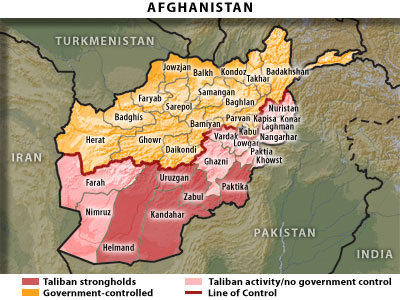
Interesting Maps

In this post I am posting some interesting maps I saved from Stratfor reports. As Indians the maps on the current status of Afghansitan and Sri Lanka will be of particular interest to us.


The Child In Us


Here is Amitabh Bachchan being - after posing for the group photograph - mobbed by autograph hunters who themselves are none other than fellow honourees. Looking at the photograph one thing is clear - one just don't know when the child in you will show up and that too in public.

Here is the report from the Hindu on the Delhi University special convocation where the Big B and other luminaries like Delhi CM Ms. Dikshit, cartoonist RK Laxman, scientist CNR Rao, etc were honoured.


It was doubtless a big day for Bachchan, but seemingly a still bigger day for the university. High on drama and excitement, the university abandoned some of its solemn conventions. Students turned into paparazzi — although the invitation had said no cell-phones were allowed — filming every move that Abhishek Bachchan, who arrived sporting a hair-band, made. They deployed their mobile-phones, standing on chairs. Faculty members and staff members were out in full force. And the media were out in large numbers...


Bachchan is known as a man of few words, but here, after getting his Doctor of Letters, he gave up his reticence and made a trip down memory lane. His booming baritone echoed through the freshly restored, gleaming yellow Old Vice Regal Lodge.


"The first question that came to my mind when I was told that I was getting this honour was: do I deserve it? Who would have thought that an average student, not extraordinary by any means, would be awarded such a homecoming," he said. Stating that this was an accolade he would cherish the most, Bachchan, who is 64, said he owed a lifelong debt to a university that taught him his principles and gave him an introduction to acting.


"The tall and imposing Frank Thakurdas gave me my first compliment,'' he said. "It goes without saying that nostalgia is palpable. I remember the time spent at the coffeehouse, at the bus stop outside Miranda House," he said to some hooting from the corner where students from the women's college were massed. "Yes, yes, always Miranda House,'' he finished.


While students sighed and clung to every word Bachchan uttered — apart from clapping at the mention of every film he acted from Saath Hindustani to Black as he was being introduced — many of the staff members let their hair down. "We are proud of the back gate and the bus-stop. We have to get him to come to the college now. You know he said Miranda House more times that Kirori Mal College [where he did BSc till 1962],'' gushed a Miranda House faculty member.


His presence added colour to what would otherwise have been a staid convocation, but the event appeared to have been overrun by elements of popular culture...[The Hindu]

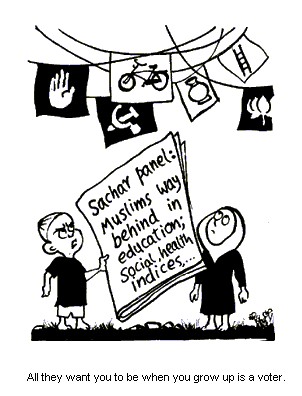
Cartoon Speak: Stark Reality

Courtesy: Indian Express.

Nov 2, 2006

US Soldiers take to Kabaddi…

...and there goes our sure shot Olympic gold.

It was always our one sure shot gold medal whenever it became an Olympic sport and I was looking forward to it. Now that too will become a gamble if the world took to it (and there is no way it can become an Olympic sport if the world doesn’t take to it). Now especially after the Americans troops have taken a fascination for it and started playing them in their barracks too the chances of Kabaddi becoming a global sport is pretty good. After all as one of the commenters pointed out at “Sepia Mutiny” Kabaddi is American football minus the ball.


After a joint anti-terrorism exercise [Shatrujeet 2006, the counter-terrorism exercise in which a company of the Punjab Regiment's 21st Battalion and 2/4 Marine company of US Army] with the Indian Army at the Commando Training Centre here, US soldiers will take back not just experience of rigorous commando training but also a quintessentially Indian sport — kabaddi.


[….]


But in the process, while training for operations like cordon-and-search or storming a terrorist hideout, the US Marines picked up kabaddi and even rudimentary cricket.


Kabaddi fascinated them, one of the American platoon commanders, Lt Lee, said. “My troops are playing kabaddi in barracks too. They are impressed with the game and the agility of the Indian troops.”


The only hitch — as an Indian officer put it tongue-in-cheek — is that the Americans pronounce kabbadi as “cup of tea”. [DNA] (Link via Sepia Mutiny)


Oct 23, 2006

To China With Love

Stratfor’s take on the Sri Lanka-US military exercises scheduled for the last week of October (since postponed link via Jaffna) is very different from the perceived notion of the United States wanting to surround India strategically. According to them it is a message to China to keep off from the Indian Ocean area because it “belongs” to India and USA.


…the site of the maneuvers [between the U.S. Marine Corps and the Sri Lankan navy] -- off the southern beaches of Hambantoa, where China is planning to build modern harbor facilities -- shows that India likely signed off on this venture as a way to signal to China that the Indian Ocean is U.S.-Indian territory.


Whatever Washington's reasons for the exercises, the maneuvers could not happen without India's permission. Though New Delhi is not nearly the geopolitical powerhouse that Washington is, the United States has anointed India as its junior partner in the Indian Ocean. The United States -- and other members of the Sri Lankan Donors Group, which assists with post-tsunami rebuilding and brokers peace talks -- traditionally consults with India on all decisions related to Colombo.


It is precisely this interest in regional pre-eminence that led India to give the go-ahead for U.S. forces to participate in a major training exercise geared toward fighting the Tamil insurgency. After all, India cannot risk offending its own sizable Tamil minority if there is not a substantial reward involved. In this case, the reward is the chance to send a targeted message to one particular country with the U.S.-Sri Lankan exercises: China.


[…]


…. The United States, with Indian assistance, intends to maintain the Indian Ocean as its own strategic waterway. China's intrusion into the area by building ports at Gwadar in Pakistan, in Myanmar and now possibly in Bangladesh irks New Delhi. Thus, it is no coincidence that the exact area of the U.S.-Sri Lankan exercises is Hambantota, the very harbor that China announced it would begin developing for Colombo in 2005.


Chinese President Hu Jintao's upcoming visit, during India's National Day, will give both sides a chance to mend some fences, but the U.S. Marine Corps exercises reveal a deeper geopolitical reality: The United States and India will not tolerate Chinese expansion, especially into the Indian Ocean.[Stratfor]

Oct 20, 2006

Stratfor's Fourth Quarter Forecast for South Asia

Our third-quarter forecast for South Asia was almost entirely accurate. Many of the core issues laid out in that forecast will continue to play out in the coming quarter. In what we described as the "Washington Effect," India and Pakistan during the third quarter largely formulated their foreign policies based on the Bush administration's priorities. Once more, South Asia's relevance in the global arena will reflect U.S. interests.


The fourth quarter begins in the intense build-up to the November U.S. congressional elections. U.S. President George W. Bush is promoting his Republican base with a clear focus on national security issues and is ramping up efforts to capture another high-value al Qaeda target to help ensure Republicans' hold on both chambers of Congress. We state in the third-quarter forecast that the Bush administration would deliver an ultimatum to Pakistani President Gen. Pervez Musharraf: Cooperate with U.S. forces and provide the necessary human intelligence to launch a successful operation and take out a key al Qaeda figure, or be left to face growing domestic opposition alone.

It appears that the Bush administration's negotiations with Pakistan are well under way. Musharraf recently announced an agreement with tribal leaders in North Waziristan to help boost his image at home after coming under severe criticism for having Pakistani security forces kill a major rebel leader. In spite of widespread concerns that the deal would create a sanctuary for Taliban militants, the United States has gone out of its way to praise Musharraf for his cooperation in the war on terrorism. Islamabad and Washington's behavior reveal that the two governments have reached an agreement to allow Musharraf to regain popularity at home in exchange for providing intelligence and greater access for U.S. forces in the region. There is a strong chance that the United States will be able to claim the capture or killing of another high-value al Qaeda target in the fourth quarter.

As in the past, a major U.S. operation on Pakistani soil would undoubtedly compromise Musharraf's domestic standing. The Pakistani president will be forced to confront intensifying opposition claims that he has sold out the country's territorial integrity to Washington. Though Musharraf is bound to run into some rough patches this quarter, he will maintain his hold over the country, mainly because of the various opposition groups' inability to overcome their own differences.

Major challenges remain for NATO forces in Afghanistan. NATO's September request for reinforcements highlights the tenacity of a resurgent Taliban. A security crisis already exists in the country, and fighting will intensify as both sides try to consolidate gains as winter approaches. Meanwhile, suicide attacks have grown more frequent and more effective; they will not decrease, even as winter sets in. Nevertheless, the Taliban is in no position to topple the government, and ultimately, the stalemate with NATO will continue.

India will begin the quarter by appearing more cooperative in reinvigorating peace talks with Pakistan, but New Delhi has little intent to move the talks forward significantly. Pakistan-based Islamist militant group Lashkar-e-Taiba (LeT) is very likely to carry out another attack in a major Indian city this quarter. Following the July Mumbai railway bombings, Indian security forces have dealt with an alarmingly high number of bomb hoaxes. Though many of these are pranks, LeT has likely staged several dry runs to time Indian security forces' responses at intended targets. Setting up numerous bomb hoaxes also allows the Kashmiri militants to confuse or distract Indian security forces. The cities of Mumbai, New Delhi and Bangalore are prime targets for such an attack. Another militant attack would prompt retaliatory attacks carried out by fundamentalist Hindu groups against Muslim targets. Should LeT carry out another bombing, relations between New Delhi and Islamabad will be strained, but an attack would not result in a substantial shift in the governments' positions or actions toward each other.

India's main struggle this quarter will be maintaining momentum on a major civilian nuclear deal that it has been trying to cement for more than a year. We correctly stated in the last quarter that the U.S.-Indian civilian nuclear agreement would not gain any real traction before the U.S. congressional elections. With time and room to maneuver on the nuclear deal, New Delhi, as we forecast, test-launched its long-range Agni III ballistic missile without fearing significant backlash from the United States over nuclear proliferation concerns.

The nuclear deal will not move forward in the fourth quarter either. With the U.S. Congress preoccupied with the November elections, a Senate vote on the deal will not be a priority. The deal could come up for discussion in a lame-duck session in November, but any final decision will not take place until after a new congressional session begins in January 2007. Should North Korea decide to ramp up its nuclear threat early in the quarter, the U.S.-Indian nuclear deal will be paralyzed. Meanwhile, India and the United States will continue to woo recalcitrant members of the Nuclear Suppliers Group, whose support will ultimately be necessary for the deal to be approved internationally.

Domestic issues will take up most of India's attention this quarter. With the nuclear deal in limbo, the ruling Congress Party once again will take up the issue of implementing a caste-based quota system for Indian universities. New Delhi's stalling on the issue has given anti-quota protesters more time to plan their demonstrations. When the quota issue was first introduced to the Indian public four months ago, students and professionals from medical, engineering and management schools poured into the streets across India to join demonstrations, many of which turned violent and ended up paralyzing business operations in major Indian cities. When the Indian Parliament takes up the issue again toward the end of this quarter, more protests can be expected throughout the country.

India will also be keeping a close eye on its war-ravaged neighbor in the south, where the Sri Lankan government has been pursuing an aggressive offensive against the Liberation Tigers of Tamil Eelam to divide the northern and eastern Tamil strongholds. As we stated in our last forecast, violence between Colombo and the Tigers steadily escalated as the Sri Lankan government continued pursuing its strategy of allowing the breakaway Karuna faction to target Tiger militants. India came under growing pressure from its own Tamil population to intervene in the crisis, as we predicted, and even publicly said it would no longer provide military assistance to Colombo. Beaten down by the military offensive, the rebel group will entertain the idea of peace talks in Oslo to buy time to recuperate from its losses and pressure Colombo to put the brakes on its military campaign. The Tigers will drag their feet in the peace talks, and hostilities will restart once the Tigers feel they are back in a position of strength. In other words, the civil war is far from over despite talk of negotiations.

Our third-quarter forecast for Nepal was on track. Negotiations between the Nepalese government and Maoists progressed, but a great deal of distrust remains between the two parties. The Parliament majority's insistence on retaining a role for the monarch and hesitance to incorporate Maoist cadres in the armed forces will likely lead to another Maoist standoff in the form of mass public demonstrations this quarter. These street protests will have a paralyzing effect on the country's economy, but the Maoists will not return to insurgent tactics this quarter. Meanwhile, the royalists in the government who have remained loyal to King Gyanendra will attempt to fuel distrust between the Maoists and the government by leaking stories of arms deliveries to the Royal Nepalese army to the press.

Another hot spot in South Asia this quarter will be Bangladesh. A 14-party opposition alliance led by former Prime Minister Sheikh Hasina is expected to stage mass protests against current Prime Minister Begum Khaleda Zia over the latter's refusal to implement electoral reforms ahead of the January elections. The riots will be marked with violence and will intensify in the run-up to the elections.[Stratfor]

Oct 16, 2006

Whose Pride?

Gujarat's or India's?


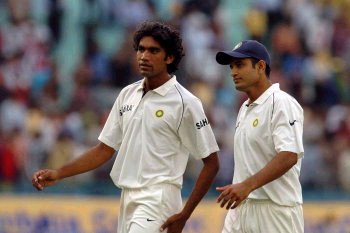
munaf and irfan


munaf and irfan

In yesterday’s cricket match between India and England if it were not for Munaf and Irfan’s deadly disciplined bowling we would have been chasing a bigger total and with the pitch playing bad towards the end, the chase would have been very difficult.

I especially loved the way Munaf kept to his line and length. To someone who has the fastest arm in India and touted as our answer to the Lees and Akhtars of this world, it must be tough to cut down on pace and stick to line and length which incidentally is already paying him good dividends.

It is good he realised it early in his career unlike Javagal Srinath who only decided to cut down on pace towards the end of his career. If I recall correctly this move of his - sticking to line and length - gave him more wickets than sheer pace. I was disappointed when Srinath suddenly announced his retirement. I really felt he had some more years of cricket in him. Anyways let bygones be bygones and let us look toward a bright future for the bowling department of our cricket team with Munaf, Irfan, Sreeshanth and others.


Related Link: An article from "Himal" on the communal situation in Gujarat today.

Secret of Pakistan's Fast Bowling Prowess


Two Pakistan speedsters on Monday tested positive for doping. Shoaib Akhtar and Mohammad Asif failed an internal PCB dope test. Both players, according to the PCB, have been asked to return to Pakistan.

The tests were conducted by the Pakistani Cricket Board and come just before the ICC tests, which were to be done through random sampling of players.
The International Cricket Council (ICC) in collaboration with the World Anti-Doping Agency (WADA) has also introduced dope test in the ICC Champions Trophy.

Two players from each of the ten participating teams were to be selected at random and subjected to dope tests by the World Anti Doping Agency officials during the Champions Trophy being played in India.

This is the first time a dope test has been introduced by the ICC in Champions Trophy. Though it was done on a trial basis during the last World Cup in South Africa, officially this is being done for the first time at the top level.

Test samples would be sent to the nearest WADA-accredited lab in Kuala Lumpur, Malaysia. There is no WADA accredited laboratory in India.

Oct 11, 2006

India, Myanmar and Realpolitiks

If there is one place our foreign policy is paying some dividends then it is in Myanmar.

According to news reports India and Myanmar have agreed to help each other with their respective dilemmas.

According to reports India has accepted Myanmar's request for military hardware and software in return for Myanmar’s full cooperation in flushing out Indian insurgent groups operating from its soil.

India, keeping its side of the bargain, has begun/will be giving Myanmar 105-mm Indian field guns, an unspecified number of retired T-55 tanks, armoured personal carriers, 105-mm light artillery guns, mortars and the indigenous advanced light helicopters at concessional rates.

Earlier in August this year, our Navy transferred two BN-2 'Defender' Islander maritime surveillance aircraft and deck-based air-defence guns and varied surveillance equipment to Myanmar. In the past we had given them 75/24 Howitzers.

Now with the cease-fire off, the Indian Army is planning a big operation against ULFA and other NE terrorist groups in early-October and security along the northeast borders has been stepped up.

As part of the bargain, Myanmar has to flush out the North East terrorist groups like ULFA, UNLF, NSCN (K), etc which have bases in the thick Myanmarese jungles. The Indian and Myanmarese armies will conduct "coordinated operations" along the 1,643-km Indo-Myanmar border. An intelligence-sharing pact has also been signed.

NDTV reported that after India supplied 98 truckloads of arms and ammunition last month, Myanmar started fulfilling its side of the bargain and has started cracking down on camps run by NSCN (K) and ULFA in Myanmar’s north.

One good thing about India’s involvement in Myanmar is that we are playing some realpolitiks – ignoring the concerns of the West - in order to counter the deep strategic inroads made by China and Pakistan into Myanmar. With the Chinese and the Pakistanis very much present there, helping the Myanmar junta militarily and economically, we had no other option other than to ditch the pro-democracy movement in Myanmar led by Aung San Suu Kyi.

With such attention showered on it by its contesting neighbours, Myanmar will be tempted to playoff one against the other and here we should be on our guard. For a country that is (in)famous for bolting the stable after the horses have fled that is a big if.

BTW, an IMF report has found that increased gas exports by Myanmar are boosting its economic growth so much so that it will end this fiscal in 2007 with 7% GDP growth! That’s better than the forecast for Uncle Sam's FATWAT Pakistan which is somewhere in six percent. And let us not forget the Americans and the Europeans have imposed economic sanctions on Myanmar coz this Junta is of no particular use to them. But that hasn’t stopped Uncle Sam’s boys from doing business with the Myanmar Junta.

Oct 6, 2006

A - Z on Dirty Bombs

This is a must read piece on Dirty Bombs from Stratfor.


Since the 9/11 attacks catapulted al Qaeda to the top of the evil-doers' list in the United States, one constant question has remained: What is al Qaeda planning now? High among the public's fears, fanned by certain events widely reported in the media, is that the jihadist network or another like-minded group or individual will unleash a radiological dispersion device (RDD), commonly referred to as a "dirty bomb," on U.S. soil.


Among the events that heightened this public interest in RDDs early on was the intense media coverage of the May 2002 apprehension of so-called al Qaeda "dirty bomber " Jose Padilla. Since 9/11, the public awareness of RDDs -- and interest in attacks that might utilize them -- has ebbed and flowed in cycles that often, though not always, are initiated by incidents or statements that get a great deal of media coverage. After the initial excitement dies down, the awareness and concern gradually falls -- until the next incident.


We now find ourselves in one of those periods of heightened awareness, this one spurred by Internet rumors of al Qaeda operatives and materials coming into the United States via Mexican smuggling routes for the purpose of creating an "American Hiroshima." Meanwhile, an audio statement was released Sept. 28 by al Qaeda leader in Iraq Abu Hamza al-Muhajer, who called for scientists to join his group's efforts against U.S. and coalition forces in Iraq, advising them that the large U.S. bases there are good places to "test your unconventional weapons, whether chemical or 'dirty' as they call them."


Considering the ease with which an RDD can be manufactured, it is only a matter of time before one is employed. In fact, it is quite surprising that one has not been successfully used already. Certainly, the time is ripe to discuss what RDDs are and are not -- and to consider the mostly likely results of such an attack.


Dirty Bombs are RDDs


An RDD, simply, is a device that disperses radiation. Depending on the motives of those involved in planning the incident, such a device could be a low-key weapon that surreptitiously releases aerosolized radioactive material, dumps out a finely powdered radioactive material or dissolves the radioactive material into water. It would be intended to slowly expose as many people as possible to the radiation. However, unless large amounts of a very strong radioactive material are used, the effects of such an exposure are more likely to be long-term rather than sudden and dramatic: people dying of cancer rather than acute radiation poisoning.


By its very nature, however, this kind of RDD will not generate immediate panic or the type of press coverage coveted by most terrorists. Therefore, they more likely will opt for a RDD that delivers a more "spectacular" punch -- a dirty bomb, in other words. The opposite of a surreptitious device, a dirty bomb is intended to immediately cause panic and mass hysteria.


A dirty bomb is simply a RDD made of a traditional improvised explosive device (IED) with a radiological "kicker" added. In a dirty bomb attack, radioactive material not only is dispersed, but the dispersal is accomplished in an obvious manner, and the explosion immediately alerts the victims and authorities that an attack has taken place. The attackers hope notice of their attack will cause mass panic.


Effects of a Dirty Bomb


Perhaps the biggest misconception about dirty bombs -- and there are many -- has to do with their effects. Although radioactive material is utilized in constructing them, they are not nuclear or atomic weapons. They do not produce a nuclear chain reaction and, therefore, the employment of such a device will not produce an "American Hiroshima." In fact, there can be a wide range of effects produced by a dirty bomb depending on the size of the IED and the amount and type of radioactive material involved. Environmental factors such as terrain, weather conditions and population density would also play an important role in determining the effects of such a device.


Generally, a dirty bomb that uses a large quantity of highly dangerous radioactive material such as plutonium-238 or cesium-137 will produce more (and stronger) contamination than a device that uses less material or material that is not as radioactive. However, the most highly radioactive materials are the hardest to obtain and the most difficult to work with. Some materials are so dangerous that even suicide bombers would die before they could use one if they were not properly shielded. For example, in September 1999, two Chechen militants who attempted to steal highly radioactive materials from a chemical plant in the Chechen capital of Grozny were incapacitated after carrying the container for only a few minutes each; one reportedly died.


There are, however, many more-common, less-dangerous materials, such as americium-241 or strontium-90, that would be easier to obtain and work with. It is therefore widely believed that terrorists wanting to construct a dirty bomb would be more likely to use one of them.


According to experts from organizations such as the National Council on Radiation Protection and Measurements, unless a large quantity of a very highly radioactive material is used, not many people will be immediately killed by the radiation released by a dirty bomb. Rather, the initial casualties will be a result of the explosive effects of the IED, just as they would be in a conventional IED attack without a radiological component. While exposure to very strong sources of radiation at close range could cause fatalities, a dirty bomb by design disperses its radiation over a larger area. Therefore, most of the deaths caused by the radiation in a dirty bomb will most likely be from causes like cancer that will take years to develop. Most people who quickly leave the area contaminated by the dirty bomb will have minimum exposure to radioactivity and should not suffer permanent health consequences.


Keep in mind, however, that a dirty bomb is intended to cause a panic -- and the explosion of such a device in a heavily populated urban area could very well result in a panic that could kill more people than the IED or the radiation it disperses.


It should also be noted that the radiological effects of a dirty bomb will be larger than the killing radius of the IED itself, and will persist for far longer. The explosion from a conventional IED is over in an instant, but radiation from a RDD can persist for decades. While the radiation level may not be strong enough to affect people who are exposed briefly in the initial explosion, the radiation will persist in the contaminated area and the cumulative effects of such radiation could prove very hazardous. (Here again, the area contaminated will depend on the type and quantity of the radioactive material used. Materials in a fine powdered form are easier to disperse than solid blocks of material and some radioactive materials possess a far longer half-life than others.) Due to this contamination, it will be necessary to evacuate people from the contaminated area in many, if not most, cases involving a dirty bomb. People will need to stay out of the area until it can be decontaminated, a process that can be lengthy and expensive.


Therefore, while a dirty bomb is not truly a weapon of mass destruction (WMD) like a nuclear device, many authorities refer to them as "weapons of mass disruption" or "weapons of mass dislocation" because of the fact that they temporarily render the contaminated areas uninhabitable. The vast expense of decontaminating a large, densely populated area, such as a section of Manhattan or Washington, would also make a dirty bomb a type of economic weapon.


The Actors


Due to the ease of constructing a dirty bomb -- which is really just an IED plus a source of radioactivity -- such a device could be employed by almost any terrorist actor ranging from a "lone-wolf" domestic terrorist to a transnational militant organization such as al Qaeda. However, when considering that the effects of such a device are more likely to be symbolic and economic, the equation begins to shift toward the al Qaeda side, as symbolic targets that harm the U.S. economy are dead in the center of the jihadist network's targeting sweet spot. Al Qaeda also has a history of planning to use such weapons.


In his recent statements about using dirty bombs against U.S. bases in Iraq, al-Muhajer did not present a novel idea. Many in the jihadist universe have a strong fascination with WMDs, and many jihadist Web sites, such as chat rooms and online magazines, regularly post information on how to produce chemical agents, biological toxins, RDDs and even improvised nuclear weapons. Some posts provide instructions on where to obtain radioactive material and, in cases where it cannot be obtained, even purport to provide instruction on how to extract radioactive material from commercial materials, such as distilling radium from luminescent industrial paint.


More specifically to al Qaeda, evidence uncovered in Afghanistan following the U.S. invasion demonstrated that the group was actively pursuing a WMD program that included research on chemical, biological, nuclear and radiological weapons. Based on this evidence, and information obtained from the interrogations of captured high-level al Qaeda members, U.S. intelligence agencies have specifically and repeatedly warned since late 2001 that al Qaeda intends to produce and employ a RDD. When these reports surface, the flow cycle of public concern over RDDs begins anew.


Despite the simplicity of manufacturing dirty bombs, however, they are not often used, possibly due at least in part to their ineffectiveness. Governments such as that of Iraq that experimented with dirty bombs for military purposes abandoned them because they were not effective enough to be militarily significant as a weapon or provide much of a deterrent.


Perhaps the group that has used or attempted to use RDDs the most is the Chechen militants. In November 1995, Chechen militants under commander Shamil Basayev placed a small quantity of cesium-137 in Moscow's Izmailovsky Park. Rather than disperse the material, however, the Chechens used the material as a psychological weapon by directing a television news crew to the location and thus creating a media storm. The material in this incident was thought to have been obtained from a nuclear waste or isotope storage facility in Grozny.


In December 1998, the pro-Russian Chechen Security Service announced it had found a dirty bomb consisting of a land mine combined with radioactive materials next to a railway line. It is believed that Chechen militants planted the device.


The Bottom Line


Analytically, based upon the ease of manufacture and the jihadist interest in dirty bombs, it is only a matter of time before jihadists employ one. Since the contamination created by such a device can be long-lasting, more rational international actors probably would prefer to detonate such a device against a target that is outside of their own country. In other words, they would lean toward attacking a target within the United States or United Kingdom rather than the U.S. or British Embassy in their home country.


Since it is not likely to produce mass casualties, a dirty bomb attack would likely be directed against a highly symbolic target, such as one representing the economy or government, and designed to cause the maximum amount of disruption at the target site. Therefore, it is not out of the question to imagine such an attack aimed at Wall Street or the Pentagon. The bomb would not destroy these sites, but would deny access to them for as long as it takes to clean up the sites.


Due to the history of RDD threats, the U.S. government has invested a great deal of money in radiation detection equipment, and has strategically located that equipment along the border at ports of entry and near critical sites. If the rumors of radioactive materials being smuggled over the Mexican border are true, the terrorists would want to detonate the device in a city close to the border out of fear that this network of detection systems would allow the material to be detected and seized by U.S. authorities before it could be employed.


The Importance of Contingency Plans


The possibility of an RDD attack underscores the importance of having personal contingency plans. This is especially important for those who live or work near one of these potential targets. In the case of a dirty bomb attack, it will be important to stay calm. Panic, as we have said, could potentially kill more people than the dirty bomb itself. The best countermeasure against irrational panic is education. People who understand the capabilities and limitations of dirty bombs are less likely to panic than those who do not.


People caught in close proximity to the detonation site, then, should avoid breathing in the dust as much as possible and then calmly leave the area, paying attention to the instructions given to them by authorities. If possible, they also should bathe and change clothes as soon as possible, and implement their personal or family emergency plan. People not in the immediate vicinity of the dirty bomb should seek shelter where they are -- making sure to close windows and doors and turn off air conditioners -- unless they are instructed to go elsewhere.


However, should communication from the authorities break down or the authorities not provide instruction, the three most important things to remember about protecting oneself from radiation are time, distance and shielding. That means minimizing the time of exposure, maximizing the distance between the person and the radiation source and maximizing the amount of shielding between the person and the radiation source.[Stratfor]

Oct 2, 2006

Ticket to Mecca and Medina

It all started in the Muslim community with the rise of BJP to power in the North Indian states and later at the center. With communal bitterness very much in the air at that point of time, some crazy Mullahs – especially of Uttar Pradesh - started spreading canard by issuing fatwas that the oral polio vaccine administered to children was part of the government’s population control scheme particularly targeted at the Muslims. In Muslim dominated areas, posters were put up telling the people that the polio vaccine is part of an underhanded campaign to sterilise Muslim children and lower the Muslim birth rate. The semiliterate, illiterate and the ignorant of the community were easily influenced and many of them withheld their children from getting vaccinated.


So what happened? Muslim children stated getting affected with polio virus. Living in unhygienic areas with poor waste disposal and no access to clean water, transmission of the virus became very easy among the Muslim poor. And with people in such areas defecating in the open, as they don’t have access to lavatory, fecal-oral transmission of the virus became very easy. Polio usually infects children through drinking water contaminated with the excreta of the polio affected.


The governments changed but the distrust didn’t go away. The administrations didn’t give up and tried every trick in the book to drive home the importance of polio vaccination. Even celebrities like Amitabh Bachchan were roped in. It seemed like getting the desired results and India was on the verge of eliminating polio last year, when only 66 cases were reported, down from 1600 in 2002. This year, however, things have gone horribly wrong with the polio eradication drive - 338 cases have been reported already with 70% of those infected with polio are Muslim.


It seems the very old reasons are in play again in the Muslim community. This time the villain is not the present Muslim friendly Indian or the state governments, but the West. According to some Mullahs it is a Western plot to reduce the Muslim birth rate! So none of the present government’s initiatives to drive home the truth are having any effect because Mullahs’ fatwa is always the gospel truth for most of them. Even the health workers are beaten up and denied entry in Muslim dominated areas.


If the damage done by fatwas issued by neurotic Mullahs was not enough, the Urdu press - expected to be an upholder of truth - is busy fueling these rumours by publishing utter crap like “polio immunisation would lead to brain tumor and cancer”!


With such determined effort in the Muslim community- with neurotic Mullahs and the Urdu press joining forces - to keep their children from vaccination, the Indian and the state govts definitely have an uphill task.


But there is a glimmer of hope on the horizon. Saudi Arabia has decided to receive only polio-free pilgrims and has made it mandatory for Haj travellers below 15 years of age from all polio-infected countries to provide proof of immunisation. Without this certificate Muslims cannot enter Saudi Arabia to perform Haj. Now, for every Muslim it is mandatory to perform Haj at least once in their lifetime. So - at least for their own spiritual good - it is time responsible Indian Muslims took up the task of driving home the positive aspects of immunisation. The blunt message from the land of Mecca and Medina for the faithful is: you aren’t welcome if you aren’t immunised.