May 31, 2006
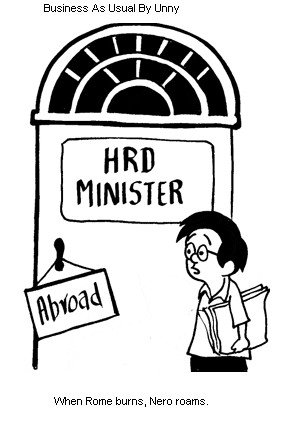

Yippee! Its 9.3%!
Yes, the GDP grew in Q4 by 9.3%! Now if the gods are going to bless us with abundant rains this year, then this rate is only going to improve. So buckle up for the exciting ride ahead for the economy. Interest rates could further rise .
BTW, the full-year GDP growth for 2005/06 was 8.4 per cent as compared to 7.5 per cent in the previous fiscal.
From My Heart
Listen to Your Conscience
I am very much disturbed by some of the recent developments in this country of mine. First of all it’s the reservation issue on which I didn’t voice my opinion earlier because I knew it was sheer political opportunism by the UPA govt to win the OBC votes in next year’s UP state elections. Medicos are leading the anti-reservation agitation and because of this, poor patients are suffering for no fault of theirs. I completely support the anti-reservation movement but I think it is high time now Engineering, Law, MBA, etc, students and people from the private sector took the lead. I think Medicos should go back and treat the patients. The Socrates Law by which the Medical fraternity swears thus states:
I swear to fulfill, to the best of my ability and judgment, this covenant:
I will respect the hard-won scientific gains of those physicians in whose steps I walk, and gladly share such knowledge as is mine with those who are to follow.
I will apply, for the benefit of the sick, all measures [that] are required, avoiding those twin traps of overtreatment and therapeutic nihilism.
I will remember that there is art to medicine as well as science, and that warmth, sympathy, and understanding may outweigh the surgeon's knife or the chemist's drug.
I will not be ashamed to say "I know not," nor will I fail to call in my colleagues when the skills of another are needed for a patient's recovery.
I will respect the privacy of my patients, for their problems are not disclosed to me that the world may know. Most especially must I tread with care in matters of life and death. If it is given me to save a life, all thanks. But it may also be within my power to take a life; this awesome responsibility must be faced with great humbleness and awareness of my own frailty. Above all, I must not play at God.
I will remember that I do not treat a fever chart, a cancerous growth, but a sick human being, whose illness may affect the person's family and economic stability. My responsibility includes these related problems, if I am to care adequately for the sick.
I will prevent disease whenever I can, for prevention is preferable to cure.
I will remember that I remain a member of society, with special obligations to all my fellow human beings, those sound of mind and body as well as the infirm.
If I do not violate this oath, may I enjoy life and art, respected while I live and remembered with affection thereafter. May I always act so as to preserve the finest traditions of my calling and may I long experience the joy of healing those who seek my help.
Written in 1964 by Louis Lasagna, Academic Dean of the School of Medicine at Tufts University, and used in many medical schools today.
Reading this it is very clear that a doctor’s first duty is to attend to the sick. The doctors should find other peaceful means of protest – like wearing black coat, black bandana, etc. At least the medicos should heed the Supreme Court's directions in this matter.
Enough is Enough
Another thing that is bothering me is the developments in Gujarat. All that Aamir Khan asked was to properly rehabilitate the people who will be displaced once the Sardar Sarovar Dam’s height is increased. For this some Gujaratis labelled him anti-Gujarat. Everyone knows the importance of the dam for the states of western India but that doesn’t mean we trample upon a section of our people to provide water to another section of our people.
The Aamir Khan Vs Gujarat spat is now reaching preposterous levels of insanity. As Gujarat cinemas fearing violence by politicians have banned “Fanaa”, some guys who obviously are big Aamir Khan fans decided to go to Mumbai to watch the movie. Now some fellow Gujaratis have labelled them ‘traitors’ and don’t want them back in Gujarat and they also want them expelled from University. The ban however doesn’t stop anyone in Gujarat watching pirated version of “Fanaa” on DVD.
The Aamir Khan Vs Gujarat spat is now reaching preposterous levels of insanity. As Gujarat cinemas fearing violence by politicians have banned “Fanaa”, some guys who obviously are big Aamir Khan fans decided to go to Mumbai to watch the movie. Now some fellow Gujaratis have labelled them ‘traitors’ and don’t want them back in Gujarat and they also want them expelled from University. The ban however doesn’t stop anyone in Gujarat watching pirated version of “Fanaa” on DVD.
Hatred and intolerance in BJP ruled Gujarat a.k.a laboratory of Hindutva is a grave matter of concern. Sonia Gandhi’s pet project NREGA, (which has been badly trashed by some economists) could become – if initial reports are to be believed – a successful project in giving employment in rural areas. If India’s rural economy can grow by1%, it will translate into a 10,000 crore market for goods and services. Just this week ‘‘Indian Express” has exposed how in Narendra Modi’s Gujarat, Hindu villagers have left Muslims out of this project in most areas. There are exceptions in Gujarat where Muslims and Hindus are together in this project.
Recently in Vadodara after a very old dargha, which was declared as an encroachment was demolished, riots broke out and as usual Hindus and Muslims killed each other. How long are the Gujaratis going to live like this? Can’t they forgive each other and live peacefully? Why bring a bad name for rest of us Indians? Why do they link everything to Gujarati “asmita”? What about India’s ‘asmita’? Are they more Indian than rest of us? Where is this madness going to stop? There was a time when Gujaratis were held in great esteem by rest of us Indians for their business acumen and hospitality. Today it is different and it is a sad development.
May 30, 2006
Digging One's Grave?
Kumar Ketkar in an article in Indian Express explains how the present pro-OBC stance of Congress will ultimately harm the party than do any good for them. The article is very informative on caste politics of independent India.
Not many people remember Charan Singh, the man who appointed B.P. Mandal to head a commission in the late ’70s to collect data on the Other Backward Classes (castes), belonged to the Congress Party till the mid-1960s. He left the Congress to form Bharatiya Kranti Dal because he felt the agriculturists did not get justice and a fair deal in the Nehruvian system.
The Jat leader of Uttar Pradesh’s farmers was actually reflecting the aspirations of the “middle peasantry”. Translated in caste terms, it meant that the so-called OBCs (sometimes known as middle castes, and also “forward castes”) were left out and impoverished by the Congress Capitalism. Almost all Lohiaite socialists and some communists at once empathised with Charan Singh. While the capitalists used to criticise Nehru for being socialist, the socialists and comrades would often condemn him for being capitalist.
Charan Singh was not advocating the cause of the agricultural labour, surviving far below the poverty line, nor was he championing the demands of the landlords. He was articulating the political and economic ambitions of the OBCs, who were not part of the Congress System. The Congress System was a rather vague manifestation of aspirations of all classes and castes. Till the mid-sixties that vagueness helped the party to appeal to all sections of the electorate. But two decades after Independence, there were murmurs of resentment in the rural north. The so-called Hindi belt had not gone through social movements and the production relations remained steel-framed by the tight caste structure.
The Congress culture had been able to co-opt the Scheduled Castes and Tribes by offering them affirmative action in the form of reservations. Indian society took these reservations in its stride. There was a feeling of guilt among the upper castes, which actually were at the helm of all the parties of the Left and Right. The conservative opposition to those reservations did not cause protest, like the one we are witnessing today.
The OBCs may have been poor but were not untouchables. Also, a large number of them owned land and cattle. Many OBCs were skilled craftsmen. The OBCs occupied a vast socio-economic space in rural India. They were hostile to the former untouchables. Indeed, caste relations between the OBCs and the BCs were far more vicious and violent than between the upper castes and the dalits. Most dalits were landless labourers and lived at the mercy of the OBC landowner. There were a few upper caste landlords, but by and large the agricultural means of production were controlled and owned by the OBCs.
The upper castes had learnt quite early, almost by intuition, that the future belonged to the knowledge industry. They had begun to invest in education. Therefore the primary contradiction in the rural society was not Brahmins versus the BCs, but the BCs versus the OBCs. Indeed, hardline casteism prevailed more among the OBCs and even the BCs, as they observed the hierarchy very strictly. Whether it was drawing water from the village well, going to temple or marrying a lower of higher caste partner within BC or OBC ranks, it generated hatred, murder or mass violence.
Landlordism was formally abolished in 1951, but it had taken other forms. The restructured landlord and his henchman, the moneylender and their allies in the police and bureaucracy represented the actual ruling class. The well-off OBCs represented that ruling class. This class began to become more and more assertive and aggressive after acquiring larger economic clout in the ’60s. Charan Singh became its spokesperson.
This OBC aggressiveness was predominantly a northern phenomenon. Maharashtra and the southern states had their versions of middle-caste political movements but the violence and viciousness was not so intense there.
The Congress political culture received its first jolt in the ’67 elections, as it lost power in the entire north. The newly formed Samyukta Vidhayak Dals were nothing more than the casteist OBC fronts. Indira Gandhi had come to power just about a year ago. It was a blow to her and the rivals within the party decided to challenge her leadership. The party was split in 1969 and she had to once again take a kind of ‘hold all’ approach to appeal to all sections of people. The slogan “garibi hatao” reflected the old Congress style. The OBC fronts and their Left allies could not hold on to power, as they could not mobilise allies. Also, the OBC base was not large enough.
Their opportunity came in 1977, when the Janata Party came to power. The so-called JP movement had actually mobilised this class and given it political legitimacy. To consolidate the political gains after coming to power, the Charan Singh faction confronted Prime Minister Morarji Desai and the compromise was the Mandal Commission.
But the collapse of the Janata Dal government and Indira Gandhi’s return stalled the OBC advance. She knew the OBC rebellion was aimed at destroying the Congress culture. She shelved the Mandal report, submitted to her government in 1980. But the OBC mobilisation continued and was challenging the Congress in every village in the north. But for Indira Gandhi’s assassination in 1984 and remobilisation of Indians transcending caste and religion, the Congress would not have come to power with such stunning majority under Rajiv Gandhi.
Rajiv was politically naive and did not initially understand the craftiness of his deputy, V.P. Singh. It was not merely Bofors and Ayodhya that defeated the Rajiv Congress. It was defeated by the OBC armies. How many people recall today that Mulayam Singh Yadav and Lalu Prasad Yadav gained clout after 1989? Both are products of the JP movement.
V.P. Singh was going to complete the cycle started by Charan Singh. When he announced unilaterally the implementation of the recommendations of the Mandal Commission, he was consciously destroying the mass base of the Congress. He knew that the Congress could be kept out of power by appealing to this new OBC power and destroying the delicate balance that the party had been able to maintain. He may have lost power, but he ruined the rainbow coalition that the Congress had represented from the days of the freedom movement. Ironically, Arjun Singh used to hate V.P. Singh then, not for political but for personal reasons. But today the same Arjun has picked up the same bows that VP had collected to attack the Congress.
If the Congress System succumbs and surrenders to the Mandal conspiracy today, it will have committed political suicide. It seems that the party leadership is paralysed and does not know how to deal with this Mandal bolt. Arjun Singh knows what he is doing just as his predecessors, V.P. Singh and Charan Singh, knew what they were doing. All these Singhs have only one aim: to wipe out forever the Congress Coalition, which represented the whole of India. If the Congress Coalition is weakened or wiped out, the day would not be too far when the Indian state too would wither away, like the Soviet state did.
I just don’t agree with Mr.Ketkar when he says that without the Congress the Indian state would wither away. He is underestimating us Indians and the power of political parties like BSP. Already BSP is very confident of coming to power in the center in 10-15 years time. The Brahmins must have realized this already and perhaps that explain why in UP they are joining BSP in large numbers. I am still to figure out what Arjun Singh will get by wiping out the Congress party from India.
Not many people remember Charan Singh, the man who appointed B.P. Mandal to head a commission in the late ’70s to collect data on the Other Backward Classes (castes), belonged to the Congress Party till the mid-1960s. He left the Congress to form Bharatiya Kranti Dal because he felt the agriculturists did not get justice and a fair deal in the Nehruvian system.
The Jat leader of Uttar Pradesh’s farmers was actually reflecting the aspirations of the “middle peasantry”. Translated in caste terms, it meant that the so-called OBCs (sometimes known as middle castes, and also “forward castes”) were left out and impoverished by the Congress Capitalism. Almost all Lohiaite socialists and some communists at once empathised with Charan Singh. While the capitalists used to criticise Nehru for being socialist, the socialists and comrades would often condemn him for being capitalist.
Charan Singh was not advocating the cause of the agricultural labour, surviving far below the poverty line, nor was he championing the demands of the landlords. He was articulating the political and economic ambitions of the OBCs, who were not part of the Congress System. The Congress System was a rather vague manifestation of aspirations of all classes and castes. Till the mid-sixties that vagueness helped the party to appeal to all sections of the electorate. But two decades after Independence, there were murmurs of resentment in the rural north. The so-called Hindi belt had not gone through social movements and the production relations remained steel-framed by the tight caste structure.
The Congress culture had been able to co-opt the Scheduled Castes and Tribes by offering them affirmative action in the form of reservations. Indian society took these reservations in its stride. There was a feeling of guilt among the upper castes, which actually were at the helm of all the parties of the Left and Right. The conservative opposition to those reservations did not cause protest, like the one we are witnessing today.
The OBCs may have been poor but were not untouchables. Also, a large number of them owned land and cattle. Many OBCs were skilled craftsmen. The OBCs occupied a vast socio-economic space in rural India. They were hostile to the former untouchables. Indeed, caste relations between the OBCs and the BCs were far more vicious and violent than between the upper castes and the dalits. Most dalits were landless labourers and lived at the mercy of the OBC landowner. There were a few upper caste landlords, but by and large the agricultural means of production were controlled and owned by the OBCs.
The upper castes had learnt quite early, almost by intuition, that the future belonged to the knowledge industry. They had begun to invest in education. Therefore the primary contradiction in the rural society was not Brahmins versus the BCs, but the BCs versus the OBCs. Indeed, hardline casteism prevailed more among the OBCs and even the BCs, as they observed the hierarchy very strictly. Whether it was drawing water from the village well, going to temple or marrying a lower of higher caste partner within BC or OBC ranks, it generated hatred, murder or mass violence.
Landlordism was formally abolished in 1951, but it had taken other forms. The restructured landlord and his henchman, the moneylender and their allies in the police and bureaucracy represented the actual ruling class. The well-off OBCs represented that ruling class. This class began to become more and more assertive and aggressive after acquiring larger economic clout in the ’60s. Charan Singh became its spokesperson.
This OBC aggressiveness was predominantly a northern phenomenon. Maharashtra and the southern states had their versions of middle-caste political movements but the violence and viciousness was not so intense there.
The Congress political culture received its first jolt in the ’67 elections, as it lost power in the entire north. The newly formed Samyukta Vidhayak Dals were nothing more than the casteist OBC fronts. Indira Gandhi had come to power just about a year ago. It was a blow to her and the rivals within the party decided to challenge her leadership. The party was split in 1969 and she had to once again take a kind of ‘hold all’ approach to appeal to all sections of people. The slogan “garibi hatao” reflected the old Congress style. The OBC fronts and their Left allies could not hold on to power, as they could not mobilise allies. Also, the OBC base was not large enough.
Their opportunity came in 1977, when the Janata Party came to power. The so-called JP movement had actually mobilised this class and given it political legitimacy. To consolidate the political gains after coming to power, the Charan Singh faction confronted Prime Minister Morarji Desai and the compromise was the Mandal Commission.
But the collapse of the Janata Dal government and Indira Gandhi’s return stalled the OBC advance. She knew the OBC rebellion was aimed at destroying the Congress culture. She shelved the Mandal report, submitted to her government in 1980. But the OBC mobilisation continued and was challenging the Congress in every village in the north. But for Indira Gandhi’s assassination in 1984 and remobilisation of Indians transcending caste and religion, the Congress would not have come to power with such stunning majority under Rajiv Gandhi.
Rajiv was politically naive and did not initially understand the craftiness of his deputy, V.P. Singh. It was not merely Bofors and Ayodhya that defeated the Rajiv Congress. It was defeated by the OBC armies. How many people recall today that Mulayam Singh Yadav and Lalu Prasad Yadav gained clout after 1989? Both are products of the JP movement.
V.P. Singh was going to complete the cycle started by Charan Singh. When he announced unilaterally the implementation of the recommendations of the Mandal Commission, he was consciously destroying the mass base of the Congress. He knew that the Congress could be kept out of power by appealing to this new OBC power and destroying the delicate balance that the party had been able to maintain. He may have lost power, but he ruined the rainbow coalition that the Congress had represented from the days of the freedom movement. Ironically, Arjun Singh used to hate V.P. Singh then, not for political but for personal reasons. But today the same Arjun has picked up the same bows that VP had collected to attack the Congress.
If the Congress System succumbs and surrenders to the Mandal conspiracy today, it will have committed political suicide. It seems that the party leadership is paralysed and does not know how to deal with this Mandal bolt. Arjun Singh knows what he is doing just as his predecessors, V.P. Singh and Charan Singh, knew what they were doing. All these Singhs have only one aim: to wipe out forever the Congress Coalition, which represented the whole of India. If the Congress Coalition is weakened or wiped out, the day would not be too far when the Indian state too would wither away, like the Soviet state did.
I just don’t agree with Mr.Ketkar when he says that without the Congress the Indian state would wither away. He is underestimating us Indians and the power of political parties like BSP. Already BSP is very confident of coming to power in the center in 10-15 years time. The Brahmins must have realized this already and perhaps that explain why in UP they are joining BSP in large numbers. I am still to figure out what Arjun Singh will get by wiping out the Congress party from India.
May 29, 2006
Press Versus Bloggers
Finally, the mainstream press worldwide is feeling the heat from the blogger community. So much so that they are discussing how to beat the bloggers and citizen journalists to the story in the International Press Institute's World Congress in the Scottish capital, Edinburgh!
Now this shouldn't surprise the blogger community at all. After all didn't the best coverage of the London bombing, South Asia Tsunami, etc was by the bloggers. Recently Nitin's success in getting Harper Collins to correct the error committed by Clinton in his foreword to Madeline Albright's book is worth being noted. IMO this is the biggest success for an Indian blogger till date.
Rajdeep Sardesai's CNN-IBN is very keen on partnership between citizens and the mainstream media. Their Citizen Journalist initiative is a commendable one in this regard. They encourage citizens to contact them with "breaking news" from their respective areas and after verifying its authenticity, it will go on air.
More Power to Bloggers!
May 23, 2006
‘‘India is not a democratic country’’
‘‘India is not a democratic country’’. ‘‘The biggest PR mythof all times is that India is a democracy. In reality, it is not,’’
The loony lady is at it again. Once again in a foreign land as usual she attacks her “motherland”. This time she has crossed all acceptable limits. Midway from a book reading session in NY, she thus pontificated. Then this educated twit said:
She was confused, as India was passing through a terrible time.
“Terrible time”?! So a country growing at 8% is having a terrible time. I have some minor renovation work to be done at home and its been three weeks and I am yet to find a mason who can spare some time.
‘‘There is no real democracy in India. Several states in India are on the vergeof c ivil war,’’ she said.Challenging the much-acclaimed views of columnistThomson Friedman praising India, a democracy of a billion population, forconducting peaceful elections year after year, she said, ‘‘He probably needs anew tour of India... Does Thomas know that in Kashmir Valley alone, some 80,000people have been killed? In Iraq, there are 1,50,000 military personnel, whereasin Kashmir Valley there are some 7,00,000.’’
When she talked about civil war I thought she was referring to the polarisation of the country due to the reservation issue. The ignoramus that I am should have known better. For that terrorist sympathiser what is troubling is those ‘poor’ Kashmiris getting killed in JK and the seven-lakh strong Indian army’s presence in JK. Now this is not the first time she has made such remarks. Why does she hide the fact that the 80,000 (the figure is pretty old now… Roy, next time do add some more zeros for greater effect) killed in Kashmir include civilians, terrorists and army men? And that the majority of the civilians were Muslims and were killed by Paki trained Islamic terrorists. If she loves those Kashmiris so much why restrict her love only to the ones on this part of LoC? Why no concern for the people of Gilgit, Baltistan and ‘Azad Kashmir’ who are treated by Pakistani Punjabis as their “subjects”.
The Naxals kill with impunity poor people from Andhra to Nepal who are pretty similar to the ones she was recently supporting in New Delhi and not a single condemnation has been there from her till today.
Yes, we do hold peaceful elections year after year and one round of state elections just concluded with her favourite party winning in two states.
Now, that according to this nutcase we are not a democracy, the moment she lands here, she should be arrested for anti-India activities. No, better still, let us do a Musharraf on her – declare Arundhati Roy a persona non grata. After that she must be very welcome in Pakistan to live the rest of her life there.
Related Link: Sandeep recommends Ms.Roy Saudi Arabia, China, etc apart from Pakistan.
May 22, 2006
Why Attack Friends?
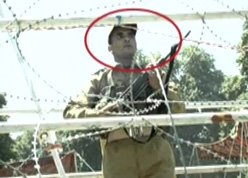
That is the picture of one of the terrorists who attacked the Congress Rally in Srinagar on Sunday. But what baffles me is that why do the terrorists kill their friends when they are helping them in all possible ways.
May 19, 2006
Tribal Shining
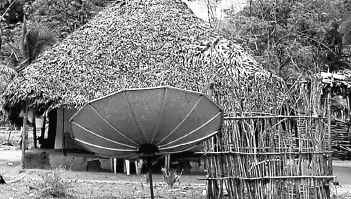 A fast changing India doesn't leave anyone behind - the tribals including!
Cinema theatres or dish antennas to TV sets are no more entertainment to tribals in East Godavari agency area. Modern trends and life styles have already entered the huts of tribals even in interior forest areas like Maredumilli, Addateegala and Rampachodavaram. Recent introduction of Direct-to-Home dishes by Dooradarshan started gaining popularity in these Maoist-affected areas as laying of cables by private cable operators is not only costly, but also difficult in forest.
"Paying Rs.200 to Rs.250 per month is so expensive. So, three to four families who are mostly relatives bought DTH dishes from Rajahmundry and getting more than 40 channels through it," said Kunjam Pentannadora of Chinabarangi village of Rampachodavaram mandal.
During last 15 years some of the tribal houses have got portable black and white TVs in villages like I. Polavaram, Musurumilli, Seethapalli and Devipatnam areas. "First it was black and white TV in my house and we bought colour TV two years ago.
But, the programmes in Doordarshan or some times one or two Telugu channels with dots started coming with antennas," said Goragapudi Chandrarao, who passed SSC and is running a petty shop in Addateegala mandal headquarters.
When a few of the literates in the agency heard about DTH last year, they bought DTH dishes on monthly instalment basis and started enjoying almost all the Telugu, Hindi and other TV channels. "We are relaxing after we got DTH system this January. We are following Telugu TV serials regularly," said Kalum Singaramma, who works in Girijana Cooperative Corporation minor forest produce procurement centre on daily wage.
The TV channels also brought changes in tribal youth, who started wearing modern dresses in a few villages near to Rampachodavaram, Gokavaram and Korukonda.[The Hindu]
"Paying Rs.200 to Rs.250 per month is so expensive. So, three to four families who are mostly relatives bought DTH dishes from Rajahmundry and getting more than 40 channels through it," said Kunjam Pentannadora of Chinabarangi village of Rampachodavaram mandal.
During last 15 years some of the tribal houses have got portable black and white TVs in villages like I. Polavaram, Musurumilli, Seethapalli and Devipatnam areas. "First it was black and white TV in my house and we bought colour TV two years ago.
But, the programmes in Doordarshan or some times one or two Telugu channels with dots started coming with antennas," said Goragapudi Chandrarao, who passed SSC and is running a petty shop in Addateegala mandal headquarters.
When a few of the literates in the agency heard about DTH last year, they bought DTH dishes on monthly instalment basis and started enjoying almost all the Telugu, Hindi and other TV channels. "We are relaxing after we got DTH system this January. We are following Telugu TV serials regularly," said Kalum Singaramma, who works in Girijana Cooperative Corporation minor forest produce procurement centre on daily wage.
The TV channels also brought changes in tribal youth, who started wearing modern dresses in a few villages near to Rampachodavaram, Gokavaram and Korukonda.[The Hindu]
May 18, 2006
Vote Bank and Foreign Policy
"In calling India's attention to Pakistan's involvement in this outrage, Karzai implicitly invited greater Indian military involvement in Afghanistan. The manner in which India dismissed his invitation made it appear as if New Delhi was disinclined to embroil itself in what it saw as a purely bilateral squabble between Kabul and Islamabad."
[…]
"Neither Karzai nor the Northern Alliance will complain too loudly if Indian special forces are deployed to protect Indian interests. Some may argue against the use of force in Afghanistan, contending that this is not India's war. If that is so, it is hard to explain India's massive investment in the reconstruction."
Nitin is right as always. But the question is why is India not ready to play a military role in Afghanistan when we are increasing our investments in that country? The answer perhaps lies in our domestic politics. The present UPA govt, which wears its secular credentials on its sleeve, was stunned by the huge violent protests the Indian Muslims had staged against Bush visit and the Prophet Mohammad cartoon controversy. In Assam, Muslims who till the other day were with the Congress formed their own party, Assam United Democratic Front (AUDF) that cost the Congress some seats in the recent elections. Their success has now inspired the UP Muslims to launch their own political party, the Peoples' Democratic Front (PDF), to contest the UP Assembly polls next year. Till now in UP the SP, BSP and the Congress fought for the 23% of the Muslim vote pie. Now there is a new entrant and all that the Congress has meticulously planned to woo the Muslims to its side will come to knots if Congress-led UPA deployed our special forces in Afghanistan.
Another matter is that even though we see our armed forces as a secular force, it is not necessary that others see the forces of a mostly Hindu nation as secular. And it doesn't take much effort to motivate a battle-hardened people for a jihad against the 'infidels'.
May 17, 2006
Faith Interrupted
The movie on Dan Brown's best selling novel, "Da Vinci Code" is to be released this week and Christians worldwide are against its release. In the movie, Jesus Christ is portrayed as a human who married Mary Magdalene and had a child, and that a powerful organization linked to the Church conspired to commit murder to keep it secret. Now this would clearly hurt their sentiments in the same way Hindus, Muslims,etc are hurt when their religion is denigrated.
In India, the land of "secularism and free speech", we have found a very easy way of nipping every trouble in its bud - ban the 'offender'. Nitin writes that the UPA govt would make India a laughing stock in the eyes of the world if the movie is banned. I think we became one long back when the "Satanic Verses" was banned to please the Muslims. According to Nitin it is not a matter of faith at all. He is of the opinion that the "Catholic Secular Forum" might be seeking political weight. What type of political weight are they seeking!? Just how many Lok Sabha seats are decided by Christians in India? I think we can count them on our fingers. IMO the present govt which prides itself on being "secular" might have emboldened this minority religion to clamour for a ban of the movie.
IMO if one has unflinching faith in one's religion no heresies should undermine one's faith. It is only the weak in faith who are worried about books, movies,etc that show their faith in bad light. Afterall if one doesn't have unflinching faith in one's religion, what is the purpose of being religious?
May 14, 2006
Pakistan Ordered Suryanarayana's Killing?
A Taliban Commander told Tolo TV, Afghanistan's private television channel that Suryanarayana's Killing was ordered by Pakistan's ISI. Pakistan never liked our presence in Afghanistan and the Pakistani hand was always suspected in the killings of Indians in Afghanistan. India should immediately ask for an explanation from Pakistan on this. I am sure Pakistanis will deny any hand. Enough of this peace process for now. But just to keep the Americans happy, India should go slow on the peace process.
A Taliban commander wishing to remain
anonymous previously told Tolu that Amir Khan Haqqani, whom he identified as the
military commander of Taliban fighters in Zabul Province, opposed killing K.
Suryanarayan, who was abducted by the Taliban in Zabul on April 28 (see "RFE/RL
Newsline," May 2, 2006). The source alleged that Suryanarayan was eventually
killed by Mullah Latif, a militiaman under the command of Mawlawi Mohammad Alam
Andar, on orders from Pakistan's Inter-Services Intelligence (ISI). "One thing I
would like to mention is that an Afghan national cannot commit such a crime,"
Ludin told Tolu.[Afgha.com]
Related report on CNN-IBN
May 13, 2006
India is Asia's Innovation Center
The Wall Street Journal had this interesting article on India fast becoming the innovation center of Asia. According to it due to our stringent IPR laws which is one of the toughest in the world, more and more Cos are establishing their R&D facilities in India.
India is rapidly evolving into Asia's innovation center, leaving China in the
dust. Its secret weapon? Intellectual property-rights protection. In recent
years, New Delhi has taken big steps to protect these rights, and the results
have been dramatic. It may appear as if India's recent economic rise is solely
due to its low-cost outsourcing opportunities for foreign businesses. But this
is only part of the story.Thanks to international treaties such as the Agreement
on Trade-Related Aspects of Intellectual Property (TRIPS) of the World Trade
Organization, Indian IP laws were significantly revamped starting in the
mid-1990s. In 1994, the Indian Copyright Act was amended to clearly explain the
rights of a copyright holder and the penalties for infringement of copyrighted
software. The law has been called one of the "toughest in the world."These
changes, which significantly ramped up enforcement provisions, will undoubtedly
prove the most important for copyright protection on the subcontinent -- far
ahead of other countries in Asia. The Indian courts have risen to the challenge.
They have taken a broad approach to the applying new laws -- especially to
protect intellectual property in emerging fields such as information
technology.This trend continued last year when India put in place a new patent
law that brought it further into line with international norms. For example,
this law included new provisions that extended patent protection to computer
software and pharmaceutical products. The changes provided new and powerful
incentives for investment, both foreign and domestic, in the creation of new
products in those fields. New Delhi has also improved the operation of its
Patent Office, which handles patent applications. Today, a patent can be granted
in less than three years, as opposed to only a few years ago, where it took up
to an average of five to seven years.As a result, copyright-based industries
such as the Indian IT sector have enjoyed rapid growth. The annual average rate
of growth of Indian software exports from 1994 to 2002 was 48%, marking a
drastic surge from the preceding five years, when the average annual growth was
about 35%. If New Delhi keeps up its commitment to rights protection, the
numbers will continue to grow. Within the next few years, annual revenues from
Indian software exports are expected to reach $50 billion.Furthermore, Indian
entrepreneurs, business and government labs are filing for patents at rapidly
increasing rates. The number of Indian patent applications filed has increased
400% over the past 15 years. Nearly 800 Indian companies submitted international
patent applications to the World Intellectual Property Organization in 2004.
This number may be fairly small by international standards, but is still more
than double the number of Indian patents applied for in 2000. Now, even the
local pharmaceutical companies, traditionally manufacturers of generic versions
of brand-name drugs, are embracing innovation-based business models and seeking
patent protection for their inventions.New Delhi's actions are a stark contrast
to those of others nations like China and Brazil. When it comes to reigning in
the rampant piracy of music, movies and software, these governments are lagging
behind India. But to truly reach their potential for creativity and innovation,
other emerging economic powers could take a few pointers from New Delhi. As
recent history has shown, IPR protection is the secret to success.[WSJ.com]
Where Whore Whores Legally
Prostitution is legally banned in India but in India's only Muslim majority state of Jammu and Kashmir, it was lawful all this time. After the uproar of the JK population against the sex racket that was detected recently, the JK govt is considering repealing the law that made prostitution legal in JK from 1921!
Jammu and Kashmir is the only state in the country where prostitution is legal.
According to the Public Prostitutes Registration Rules, 1921, a prostitute can
carry on her trade legally if she registers herself with the District
Magistrate. She has to fill in a simple application form, file it in person and
pay Rs 5 as fee.
[....]
Law Minister Muzzaffer Hussain Beigh, who is also
the Deputy Chief Minister of J-K, admitted the rules were still in force and
could be invoked. ‘‘Yes, the rules are in the book and are as such valid,’’
Beigh said. He, however, said the Government would repeal them in the next
Assembly session.
[.....]
Sanctioned by the Darbar of the then Maharja
Hari Singh vide Chief Minister letter No 17197, dated February 12, 1921, these
rules were first published in Government Gazette of the same year.
The rules
define a public prostitute as ‘‘a woman who earns her livelihood by offering her
person to lewdness for hire.’’ The rules also allow for the role of a brothel
keeper and defines him or her as ‘‘the occupier of any house, room, tent, boat,
or place resorted to by person of both sexes for the purpose of committing
sexual immorality.’’ However, the brothel keeper has to ensure that he does not
keep the prostitutes who are not registered with the Government.[Indian Express]
Apr 4, 2006
Sri Lankan Muslims' Link With India
The following is an article by Hindustan Times's Sri Lanka correspondent on SL Muslims' links with India.
Sri Lanka's indigenous Muslims, called Ceylon Moors, like other communities in the island, have had historical ties with India, especially Tamil Nadu and Kerala in South India.
Today, sadly, these links are very weak, if they exist at all. And they are neither remembered nor acknowledged.
Political exigencies arising from the redrawing of international boundaries after the collapse of the British Empire have put up barriers between the Ceylon Moors and India.
New identities were created, and are being constantly created. New links are forged in response to new stimuli, both domestic and international.
But India's impact on the Ceylon Moors (a community distinct from Indian Moors who are more recent Muslim migrants from India) cannot be ignored because it can be seen in the language, culture and practices of the community.
The active links have snapped, but the legacy is there for all to see.
Early migration from Kerala
Ceylon Moors are of Arab descent. Although from the earliest times, Arabs from the Gulf had been coming straight to the island for trade, the really significant migration for settlement came via the Malabar coast in what is now Kerala.
Marina Azeez, in her contribution to The Ethnological Survey of the Muslims of Sri Lanka (The Razik Fareed Foundation, Colombo, 1986) says: "The first Muslim fleet is said to have sailed to the Indian Ocean in 636 AD during the Caliphate of Omar; and since then Muslim traders began settling along the Malabar coast of India wherein pre-Islamic-time Arabs had settled as far back as the 4th.century AD."
"According to Tennent (James Emerson Tennent, London, 1859) when these settlements expanded with increase in trade as well as migration, the people spread to the coasts of Sri Lanka, settled here and carried on their trading activities."
By 7th Century AD the Arabs had settled in Kayalpatnam in what is now Tamil Nadu. From Kayalpatnam, they spread to the East and West coasts of Sri Lanka.
Although the Arabs had been traders from the earliest times, Islam gave their occupation a tremendous boost. Expansion of trade meant more settlers overseas and more converts from non-Arab peoples.
"By the 9th century AD all trade between Europe and the East was transferred to the Arabs, and by the 14th. Century AD they were operating in the region of the Persian gulf, the Indian Ocean, the Malay Archipelago and China," says Azeez.
The Arabs had displaced the Greeks and the Romans as the traders in this area.
The Muslims of Arab-Indian origin from Malabar and Kayalpatnam, along with those from Arab lands, settled in Colombo and Beruwela, a coastal town en route to Galle.
Beruwela, which retains its distinctive Muslim character even today, received its first Muslim immigrants in 1024. It is acknowledged that the art of weaving was introduced in Beruwela by migrants from Kayalpatnam.
Colombo, which has a substantial Muslim population even today, was predominantly Muslim when the Portuguese arrived in Sri Lanka in 1505, says Azeez.
Muslims of Arab and Arab-Indian descent, married local women in Sri Lanka. They mostly took Tamil wives because the Tamils populated the coast and were the local traders too.
Those who headed for the Eastern Sri Lankan coast, arrived first in Kathankudy near Batticaloa. Today, Kathankudy is perhaps the only all-Muslim town in Sri Lanka. It also has the largest number of mosques per square kilometre in the world.
In Batticaloa, the Muslim Arabs and those of Arab-Indian descent married local women from the dominant Mukkuvar caste.
The Mukkuvars were themselves early migrants from the Malabar Coast, who came to Eastern Sri Lanka via Mannar and Jaffna in the 4th century AD.
The Muslims and Mukkuvars of Batticaloa practiced matriliny or the system of tracing descent through the female line and organised themselves into matrilineal "kudis" or clans.
The administration of temples and mosques was in the hands of the kudis and the chief of the mosque was the head of the kudi with which the mosque was identified.
Adoption of Tamil language
The early Muslim settlers in Sri Lanka adopted Tamil as their spoken language.
This was because Tamil was the language of the traders in South India and Sri Lanka and it is these Tamil trader families the Muslims married into.
The Portuguese chronicler, Duartes Barbossa, wrote in the 16th.century AD that in the port of Colombo, the Muslims spoke a mixture of Arabic and Tamil and used the Arabic script to write Tamil.
Tamil, written in the Arabic script, came to be known as "Arabic Tamil".
Many Muslims in the Sinhala majority areas now say that their mother tongue is Arabic Tamil.
The Muslims of Sri Lanka produced literature in Arabic-Tamil, as well as pure Tamil, using the Arabic script, besides the Tamil script.
However, Arabic Tamil as a literary tool is not in vogue now. The Muslims today use the purest form of Tamil in their writings and formal speech. But their spoken Tamil remains unique, with the use of Arabic and Islamic words, terms and expressions.
In his paper "The Language and Literature of the Muslims" MM.Uwise says that "Muslim Tamil" is different from the Tamil spoken by Sri Lankan Tamils in terms of words used and also pronunciation.
The use of Arabic words and terms is easily noticeable.
But many of the differences could be traced to the Sri Lankan Muslims' historic links with Indian Tamils and Malayalees of Kerala.
To give just one example, "Itam" (Sri Lankan Tamil word for place) becomes "Etam" in Muslim Tamil. But in Tamil Nadu too, Itam is pronounced as Etam or Edam.
Some of the Muslim Tamil words are actually classic Tamil words, which are still in vogue in Tamil Nadu.
The Sri Lankan Muslims use "Nombu" for the "vrat" or "vritham" (fasting). Recitation of prayers is "Odhudhal" not "vaasithal." But both Nombu and Odhudhal are pure Tamil words, which are used in Tamil Nadu as substitutes for the Sanskritic terms Vritam and Vaasithal.
There are signs of Malayalam influence too. "Kudithen" (drank) becomes "kudichcha" which is but a variation of the Malayalam "kudichchu".
In Tamil Nadu Tamil too, Kudithen is Kudichchen.
Uwise says that the Tamil spoken by the Muslims living in the Sinhala areas if very different from the Tamil spoken by Muslims in the Tamil areas. He also says that the Muslims in the Sinhala areas use many Sinhala words.
But the cases he is able to cite are few and far between, and these are used only in common speech.
It cannot be denied that the Muslims in the Sinhala areas speak Tamil at home. They have been responsible for the survival of the Tamil language against great odds in the Sinhala areas.
As the renowned Tamil scholar Prof Karthigesu Sivathamby put it: "If Tamil is heard today in the villages deep inside Sinhala country, it is because of the Muslims. But for them, Tamil would have vanished from the Sinhala areas."
Earlier, Quixotic attempts by some Colombo-based elite politicians to get the Muslims to accept Arabic or Sinhala as their spoken language failed, because the love for Tamil ran in the veins of the Sri Lankan Muslims.
Performing arts
In the field of the performing arts, the influence of Tamil Nadu and Kerala is clear, though MMM Mahroof in his paper "Performing and Other Arts of the Muslims" portrays them as being of Arab origin.
Even if some of them are, they do clearly show links with India.
The Silambam or Silambattam, which shows dexterity in the handling of sticks, is portrayed as being an Arab game. However, Mahroof admits that Silambam is popular in Kerala and the Tirunelveli district of Tamil Nadu also.
The Kali Kambu dance, a dance done by men with small sticks, is also said to be Arab origin. This could well be. But the Moplahs of Kerala have a similar dance.
The Villu Pattu, a very Tamil art, is also part of the Muslim folk arts.
However, these links with Tamil Nadu and Kerala have either disappeared, or are fast vanishing because of the Islamisation of the Sri Lankan Muslims since the 1980s.
Many of these performing arts have been dubbed as being "un-Islamic" and discouraged.
Portuguese era and the Indian connection
The arrival of the Portuguese in 1505 had a devastating impact on the Muslims of Sri Lanka because the Portuguese saw them as rivals in Asian and Euro-Asiatic trade.
The Portuguese took on the Muslims both on the Malabar Coast and Sri Lanka, with an intention to drive them out, cripple them or decimate them.
Force was used unabashedly, though traders in the Asian region, including the Arabs and Arab-Indian/Ceylon Muslims, were men of peace and never used force.
As it happened, the Portuguese came to Sri Lanka via India. On hearing that Muslim ships were dodging the Portuguese men-of-war by going to the Gulf via the Maldives, the Portuguese Governor in Goa sent nine armed ships under the command of his son Don Laurenco de Almeida to decimate them. But because of bad navigation, the Portuguese commander landed in Colombo instead!
The Portuguese began to persecute the Muslims of Colombo from the word go. The Zamorin of Calicut, who had a lot of problems with the high handed Portuguese in Malabar, sent a fleet of ships to help the Muslims of Colombo resist the Portuguese.
But this did not prevent the Portuguese from virtually driving the Muslims out of the Western seaboard of Sri Lanka.
Taking pity on them, the Sinhala king of Kandy, Senarat, gave them land to cultivate in Batticaloa district on the Eastern coast.
This had a deep impact on the Muslims because traders became peasants overnight. Eventually, paddy cultivation became the single most important occupation of the community.
After the nightmare of Portuguese and Dutch rule, the Muslims rose to some freedom under British rule. Tolerance, peace and law and order, helped the growth of Muslim trade.
The Indian influence continued because the British ruled India too. Trade with the Coromandel Coast and Malabar flourished. According to the 19th.century chronicler, Alexander Johnston, the Muslims of Sri Lanka followed the trading practices of the Hindu traders of India.
Apr 3, 2006
Biotechnology Opportunities for India
An Article by Kiran Mazumdar-Shaw
Biotechnology has the potential of generating revenues of $5 billion for India; creating one million skilled jobs over the next five years through products and services. This can propel India into a significant position in the global biotech sweepstakes.
India’s position is assuming greater eminence as we continue building skills and capabilities, ranking among the top 10 biotech hubs in the world. The aim is to hit the top 5 by 2010 and the top 3 by 2015. The projected estimates envisage a market size of $5 billion by 2010 and $10 billion by 2015.
India offers significant advantages: clinical development; R&D; bio-manufacturing. The growing importance of vaccines, diagnostics and clinical trials place India in a pivotal position. It already boasts of the world’s largest vaccine production capacity. By 2010, it should have an opportunity to be a leading global bio-manufacturer of recombinant therapeutics and antibodies.
India can be positioned as the hub for differentiated medicine, offering affordable development bases for personalised medicines. Personalised therapies will demand extensive data from well differentiated patient populations, and India possesses the desired disease and patient profiles for this. Coupled with this is the need for a large number of diagnostics based on gene and non-gene based platforms. Personalised drugs also address the affordability factor for expensive therapies like cancer.
Pharmacogenomics is a rapidly growing segment providing a wealth of information pertaining to defective or missing genes which call for differentiated medicine — a new avenue for drug research. Gene regulation and other bio-algorithms will form the core of a new wave of diagnostics referred to as ‘theranostics’. Bioinformatics also offers attractive innovation and discovery opportunities in designing new drug molecules, mining novel bio markers, generating new pharmaco-genomic data and high value medical wisdom.
Custom research is a services model that most Indian biotech companies have opted for at start-up stage to earn early revenues to fund infrastructure and scientists’ salaries. This segment is expected to reach revenue levels exceeding $1 billion by 2010.
The opportunity for international bio-partnering is a fall-out of the trend of declining risk capital in the West, which seems to have dried up for companies engaged in early-stage discovery work. Indian companies would act as natural collaborators to reduce burn rates, optimise R&D spends and extend survival timelines. An ‘India Strategy’ offers an effective de-risked model for VCs who are in dire need for exit survival strategies, support for product development, and the most affordable and effective way to increase value.
There is a clear need for increased funds to encourage development. Regulatory processes also need to be streamlined (it currently involves multiple agencies), while the absence of large animal houses hinders product development. A poor patent infrastructure is also slowing innovation.
Given the right impetus however, the Indian biotechnology sector can find pride of place in the global sphere.[DNA]
Mar 31, 2006
Outsourcing: Now Printing Moolah for the World!
The outsourcing bug has truly bitten us if the latest outsourcing idea is anything to go by. Now we want to print the currency notes of the nations of the world! Till today whatever we have done in the field of outsourcing we have done it as good as the first world would have done. But in this one field I have my doubts. Going by the quality of the postage stamps, banknotes, coins, etc printed by our government printers, I think we should steer clear of this field. As someone who collected stamps a decade back, I can vouch for the quality of our government security printers. It sucks!
India may soon be the popular choice of several nations as a printer of currency. It produces the largest volume of bank notes in the world, at a third of the cost of production of established leaders. Therefore, the government is exploring tie-ups in this lucrative market, by asking some of the large currency-printing companies in Europe and the US to outsource their currency note manufacturing functions to India.
The proposal would be based on the platform provided by the recently-set up Security Printing and Minting Corporation of India. The company has a capital base of Rs 3,700 crore and has the ability to serve this rapidly-growing international market for currency notes and coins, feel sources associated with the project.
The government has already held discussions with some big banners who have shown keen interest in sourcing some key operations from here. Apart from working on lower costs, the new public sector company also has a highly-trained work force that can churn out notes and coins with advanced security features. [ET]
War on AIDS: Beginning of the End?
The best news in the war against AIDS in India is that there is a drop of 35% in new HIV cases. This is definitely good news. This could be the beginning of the end of the war on AIDS at least in South India where it is more prevalent. The most worrying is the data from North India, which I fear could be highly misleading one now. The BIMARU states have everything to help AIDS become an epidemic there. Low literacy levels meaning less awareness and coupled with migration of men folk to big cities for livelihood, is a potent mix, which can only help the AIDS virus to proliferate.
Related report in The Washington Post.
In what experts call the “best news on AIDS for India,” an Indo-Canadian team of scientists has come up with the first definitive evidence that the AIDS epidemic is slowing down in at least southern India, considered the the cradle of the disease in the country. This essentially means that the prevention program seems to be making headway and gloom-and-doom scenarios of AIDS in India need to be put into perspective
[.....]
While data from north India is still cause for worry, the Lancet study reports that prevalence of HIV-1 (the most common variant of the virus in India) prevalence fell in the southern states from 1.7% to 1.1%—a relative reduction of 35%.
[.....]
According to the research group, in recent years, the Indian government, the World Bank and other agencies have aimed intervention and awareness programmes aimed at sex workers and their efforts appear to have contributed “to a drastic decline.”
[.....]
“The good news is that HIV in young adults appears to be declining in the south—most likely or perhaps only due to men keeping away from red light area or using condoms more often when they do. The not-so-good news is that trends in the north remain uncertain and poorly studied.”
[....]
“among urban and rural women and among educated or illiterate women.” Kumar cautions that while the findings are good news, the battle is far from over. “HIV remains a huge problem in India and we have to remain vigilant,” he said. “We’re not saying the epidemic is under control yet—we are saying that prevention efforts with high-risk groups thus far seem to be having an effect.” [IE]
Mar 29, 2006
Outsourcing: Now Teleradiology
With a large pool of well-trained doctors and high tech infrastructure, India is fast emerging as a teleradiology hub.
India is providing offshore X-Ray reporting services to the US, Europe, Singapore and Middle East.
According to estimates, the US is facing a shortage of radiologists with 20 per cent of vacancies going unfilled in hospitals and increased imaging scan numbers related to a growing aged population.
"There is a worldwide shortage of qualified radiologists and teleradiology counters this shortage by providing services from one area to another. It can be used to cover the night shift from another geographic zone or to cover remote areas where there are CT or other scanners but no radiologists to interpret the results," says Dr Sunita Maheshwari, Director, Telerad Solutions, Bangalore, which is pioneer in teleradiology.
"India has an optimal time advantage with the US in terms of providing emergency night shift services to the American hospitals. We also possess high technology infrastructure base, a large pool of well-trained doctors, skilled manpower and a lower cost of living," Dr Maheshwari said.
Teleradiology means electronic transmission of radiological images, such as X-Rays, CTs and MRIs from one location to another for the purpose of interpretation and consultation.[HT]
India is providing offshore X-Ray reporting services to the US, Europe, Singapore and Middle East.
According to estimates, the US is facing a shortage of radiologists with 20 per cent of vacancies going unfilled in hospitals and increased imaging scan numbers related to a growing aged population.
"There is a worldwide shortage of qualified radiologists and teleradiology counters this shortage by providing services from one area to another. It can be used to cover the night shift from another geographic zone or to cover remote areas where there are CT or other scanners but no radiologists to interpret the results," says Dr Sunita Maheshwari, Director, Telerad Solutions, Bangalore, which is pioneer in teleradiology.
"India has an optimal time advantage with the US in terms of providing emergency night shift services to the American hospitals. We also possess high technology infrastructure base, a large pool of well-trained doctors, skilled manpower and a lower cost of living," Dr Maheshwari said.
Teleradiology means electronic transmission of radiological images, such as X-Rays, CTs and MRIs from one location to another for the purpose of interpretation and consultation.[HT]
More Power To Solar Power
President A.P.J. Abdul Kalam has plans to light up Rashtrapati Bhawan with solar power. To avoid cutting down about 15-20 trees in the compound, the project would require the construction of a new structure on which the solar panels will be mounted.
All this will cost about Rs 350 crore.
The proposed structure -- which will double up as a convention centre -- would be bigger than Vigyan Bhawan..
The president's press adviser, S.M. Khan, has confirmed that such a proposal was initiated by Kalam who recently held a meeting with experts to discuss the project. The National Thermal Power Corporation and Power Finance Corporation have formed a special purpose vehicle (SPV) to set up a 5-MW solar photovoltaic power project at the Rashtrapati Bhawan.
Kalam is said to be keen to set an example -- if Rashtrapati Bhawan can be lit up using photovoltaic solar power panels, so can rural India.
The project cost includes the setting up of power panels (estimated cost: Rs 135.70 crore) and the construction of 10 blocks with basement, ground floor and first floor for solar panels to be mounted on rooftops (Rs 206.69 crore). The project is to be located near bungalow number 1&2, Mother Teresa Cresent, Rashtrapati Bhawan. "A number of proposals have been discussed since early this month and we're awaiting directions from the president's office," said a source. "Once implemented it could act as a convention centre bigger than Vigyan Bhawan. It could also house high-profile offices, like that of various regulators."
Preliminary estimates indicate the convention centre would be able to house over 5,000 people. It can even have an underground parking.
The original proposal was to lay PV solar panels at ground level divided in 10 sub-fields in total area of 96,192 sq m. Two alternative suggestions were discussed. One was to build 10 blocks with basement and ground floor for solar panels mounted on rooftop. The available plinth area on each floor was to be about 8,537 sq m.
The second suggestion, which is understood to be most favoured, is to build it on the same pattern but on an increased floor area of 25,611 sq m for each block at an estimated cost of Rs 206.69 crore — to be constructed in 10 months.[HT]
All this will cost about Rs 350 crore.
The proposed structure -- which will double up as a convention centre -- would be bigger than Vigyan Bhawan..
The president's press adviser, S.M. Khan, has confirmed that such a proposal was initiated by Kalam who recently held a meeting with experts to discuss the project. The National Thermal Power Corporation and Power Finance Corporation have formed a special purpose vehicle (SPV) to set up a 5-MW solar photovoltaic power project at the Rashtrapati Bhawan.
Kalam is said to be keen to set an example -- if Rashtrapati Bhawan can be lit up using photovoltaic solar power panels, so can rural India.
The project cost includes the setting up of power panels (estimated cost: Rs 135.70 crore) and the construction of 10 blocks with basement, ground floor and first floor for solar panels to be mounted on rooftops (Rs 206.69 crore). The project is to be located near bungalow number 1&2, Mother Teresa Cresent, Rashtrapati Bhawan. "A number of proposals have been discussed since early this month and we're awaiting directions from the president's office," said a source. "Once implemented it could act as a convention centre bigger than Vigyan Bhawan. It could also house high-profile offices, like that of various regulators."
Preliminary estimates indicate the convention centre would be able to house over 5,000 people. It can even have an underground parking.
The original proposal was to lay PV solar panels at ground level divided in 10 sub-fields in total area of 96,192 sq m. Two alternative suggestions were discussed. One was to build 10 blocks with basement and ground floor for solar panels mounted on rooftop. The available plinth area on each floor was to be about 8,537 sq m.
The second suggestion, which is understood to be most favoured, is to build it on the same pattern but on an increased floor area of 25,611 sq m for each block at an estimated cost of Rs 206.69 crore — to be constructed in 10 months.[HT]
Kashmiri Women Entrepreneurs
Peace is literally earning several Kashmiri women dividends. Just ask Nusrat Jahan Ara. The 27-year-old heads a floriculture cooperative in Kashmir, the first such initiative in the state. A computer graduate, Ara left a government job to start the Petals and Ferns Cooperative Ltd five years ago with no money in hand. Today it has 40 members and is growing.
"When I started, I did not have a penny in my pocket. I used to take flowers from farmers on credit and send them to Delhi for sale. I used to get paid the next day and give the money to the farmers," she says. Ara represents a new breed of women entrepreneurs who are scaling new heights in Kashmir. According to the J&K industries department, out of 20,528 functional industrial units in the state, 1,008 are run by women.
Shahala Sheikh, 32, owns Wood Fort, a unit dealing in exquisite walnut furniture. A commerce graduate, she revived the business after her father's death. "He passed away when I was 14. All of us three sisters were in school at that time and nobody was there to take care of our business. I completed my studies in Bangalore, came back and revived it," she says.
Ulfat Rasool Khan, 25, has invested Rs10 lakh in a food-processing unit, Sen Foods, at Khanmoh Food Park in Srinagar. "My products will hit the market next month. I plan to start exporting since Kashmiri food is in great demand," says the commerce graduate. Rifat Mushtaq, 50, is one of the oldest women entrepreneurs in the state and has battled tremendous odds. A postgraduate in Kashmiri literature, she started a matchbox factory in 1984. "But, with the advent of militancy in 1990, my license was cancelled by the government on grounds that I was dealing in explosives," she says.
Mushtaq borrowed money from her husband and friends and started a polythene unit. When production and sales peaked, the government closed the unit on environmental considerations. Undeterred, she started a printing press. "I have 22 employees, including 12 women. My press is doing well. I have invested Rs40 lakh in it," she says.
Says GM Gania, deputy director (planning), department of industries: "Kashmiri women are coming forward and setting up industries. And they excel in their fields. This is an encouraging trend and will go a long way towards the development of our state." Women are also being seen as keen on entrepreneurship. "Women are keen on starting industries on their own. Forty per cent of the people in our classes are women," says Niala Khanday, senior faculty at the Entrepreneur Development Institute, Srinagar.
Says Prof Bashir Ahmad Dabla, dean, faculty of social sciences, University of Kashmir: "Earlier, women preferred white-collared government jobs. But such jobs have shrunk. So women are now taking risk and going in for ventures of their own. They have come of age and joined the mainstream."[DNA]
Mar 19, 2006
Pakistan's Patriot Games
I had commented in The Acorn that every terrorist on the US want list always had a Pakistani connection. This known fact had again come to light in the investigations into 9/11. Now a Pakistani weekly has revealed how Pakistani appointed lobbyists bribed 9/11 commission members to drop anti-Pakistan references from the final report.
While this was happening, the two million strong Indian American community and the India government were looking the other way. If I recall correctly we don’t even have any lobbyists at present at Capitol Hill. I always wanted our govt and our NRIs in USA to play a pro-active role in the US media – buying big ad space in influential newspapers and magazines, cultivating the media barons of US, etc. If a ‘teeny-weeny’ country like Pakistan can play dirty in US with the sole intention of protecting its interests in USA and the world then why is that we are still being the paragon of virtue?
I don’t know how much exposure this revelation by the Pakistani weekly is getting in the US. IMO this needs to get wide exposure in the US media and people should know what a sham the investigations have been. I hope the NRI community in US will make sure this expose gets the exposure it deserves in the US media.
The Pakistan foreign office had paid tens of thousands of dollars to lobbyists in the US to get anti-Pakistan references dropped from the 9/11 inquiry commission report, The Friday Times has claimed.
The Pakistani weekly said its story is based on disclosures made by foreign service officials to the Public Accounts Committee at a secret meeting in Islamabad on Tuesday.
It claimed that some of the commission members were also bribed to prevent them from including damaging information about Pakistan.
[…]
“The disclosure sheds doubt on the integrity and honesty of the members of the 9/11 inquiry commission and, above all, the authenticity of the information in their final report,” it said.
The report quoted an officer as saying that dramatic changes were made in the final draft of the inquiry commission after the lobbyists got to work. The panel was formed to probe the September 11 terror attack and make suggestions to fight terrorism.
After the commission tipped the lobbyists about the damaging revelations on Pakistan’s role in 9/11, they contacted the panel members and asked them to go soft on the country. The Friday Times claimed that a lot of money was used to silence these members.
According to the report, the lobbyists also helped Pakistan win the sympathy of 75 US Congressmen as part of its strategy to guard Islamabad’s interests in Washington. “US softened towards Pakistan only because of the efforts of the foreign office,” an official was quoted as saying in the report.
[…]
An observer at the Islamabad meeting said money could play an important role in buying powerful people. The remark came in response to comments made by some US officials after 9/11 that “Pakistanis will sell their mothers for a dollar”.
Pakistan had emerged as front-runner in the fight against terrorism unleashed by the US after the terror strikes. Washington pumped in billions of dollars to win President Pervez Musharraf’s support in launching a crackdown on al Qaida network thriving on the Pakistan-Afghanistan border. [The Telegraph]
While this was happening, the two million strong Indian American community and the India government were looking the other way. If I recall correctly we don’t even have any lobbyists at present at Capitol Hill. I always wanted our govt and our NRIs in USA to play a pro-active role in the US media – buying big ad space in influential newspapers and magazines, cultivating the media barons of US, etc. If a ‘teeny-weeny’ country like Pakistan can play dirty in US with the sole intention of protecting its interests in USA and the world then why is that we are still being the paragon of virtue?
I don’t know how much exposure this revelation by the Pakistani weekly is getting in the US. IMO this needs to get wide exposure in the US media and people should know what a sham the investigations have been. I hope the NRI community in US will make sure this expose gets the exposure it deserves in the US media.
Islamic Fundamentalism & Political Correctness
The English press in India always prided in being secular (read pro-minority). Now at least the secular right among them have started to see and understand the message on the wall that was there for a long time now. Dilip Padgaonkar has captured this 'enlightenment' of the secular press in the following article.
Most editors and columnists writing in the English-language press have seldom missed a chance to assert their liberal and secular credentials. (I should know; I’m one of them.) For decades they berated Hindu belligerence but chose to remain coy when they had to contend with Muslim fanaticism. Out of a heightened sense of political correctness, they reckoned that the extremism of the majority community was far more pernicious than the extremism of the minorities. The reason? It would spell the advent of Hindu fascism.
In the past fortnight however more and more liberal voices have begun to denounce Muslim hot-heads, and their ‘secular’ friends in the political establishment, with unabashed vigour. The former are seen to pursue an ummah-driven agenda while the latter are believed to engage in a cynical exercise to build their vote banks. And both are accused of neglecting the genuine problems plaguing the Muslim community: education, acquisition of skills, job opportunities, gender equality…
This shift in the attitude of liberals began in earnest after the 9/11 outrage in the United States and continued to gather momentum after every successive terrorist attack in the world. Willy-nilly a link was established between the suffering heaped on innocents abroad and the depredations of the terrorists in India. At stake in both cases was the internationalisation of jehadism.
It therefore stood to reason that the US-led ‘war on terror’ would find favourable echoes in India. And this, over and beyond the confines of the Sangh Parivar. That the US tied itself up in knots in the war did serve to dampen India’s initial response. One evidence of this was the country’s refusal to be associated with the emergence of Islamophobia in the West.
What seems to have got the goat of the liberals were the reactions of Muslim hot-heads and of their ‘secular’ mentors on three issues: the controversial cartoons of Prophet Mohammad, India’s stance on Iran’s nuclear designs and the Bush visit. On the first count, they argued in substance, India had nothing to do with the cartoons. Indeed, no public figure and no newspaper had endorsed the view that the controversy was all about free speech.
Against this background, the statement of a minor Muslim minister in Uttar Pradesh publicly offering a hefty reward to anyone who beheaded the Danish cartoonist came as a rude shock. Could there have been any doubt at all that this was incitement to murder? The minister received no reprimand, let alone marching orders, from Chief Minister Mulayam Singh Yadav.
The conjunction of ummah-driven politics and vote bank-driven politics became all the more apparent on the Iran issue. Until now our foreign policy has by and large not fallen prey to domestic political battles. But now a section of the citizenry, guided by religious considerations, thought it fit to challenge India’s policy on Tehran’s obduracy on nuclear inspections.
Matters reached a head when the same considerations were brought into play to protest against the Bush visit. Liberal opinion regarded the angry demonstrations staged during the presidential visit as a flagrant attempt to give pan-Islamic solidarity precedence over the national interest.
Against this backdrop, the terrorist attacks in Varanasi proved to be the proverbial last straw. Liberal opinion was convinced that the upsurge of Muslim radicalism, loudly claiming its affinity with the ummah, and the cachet of respectability it received from certain ‘secular’ political formations, had created an altogether novel situation for the country. It portended an eruption of communal tensions which would slow down economic growth and damage the nation’s security interests.
But here is the rub. Sensing the shift in the national mood, the BJP was quick to galvanise public opinion in favour of minorityism. Lal Krishna Advani’s sees his proposed rath yatra as the effective stratagem to precipitate his party’s return to power. This could well be his last chance to fulfil his prime ministerial ambitions.
Given the mood in the country, the stratagem might work. But at what cost? Should the rath yatra raise the communal fever, should it lead to riots and more terrorist attacks, you can as well bid good-bye to sustaining the GDP growth rate of recent years. And you can also say farewell to the fund of good will India enjoys in the international community, including in many Muslim countries.
The liberal hope now is that India will reject Hindu bigotry and Muslim fanaticism alike. Both threaten the idea of India which the world now celebrates with such gusto. But political correctness has well and truly run out of steam.[DNA]
Real Estate Boom
South-East Asia’s smitten, too
Though the exact value of the total real estate projects planned in India is not available, if you go by the number of projects lined up by companies from different parts of world, firms from southeast Asian countries such as Singapore, Malaysia and Indonesia seem to have cast a lusty eye on India.According to the Knight Frank India Research data, eight of the 13 residential projects proposed by foreign players in India are by companies in the southeast Asian region. Players from the US, UK, Middle East, Canada and Japan have floated one project each.“Southeast Asia nations, especially Singapore, are very bullish on Indian real estate sector. The main reasons for this is the proximity of these nations to India and the similarly in their markets. Also, Singapore firms are putting in huge funds into India because their real estate market has almost saturated and India is one of the lucrative options for them,” says Trammell Crow Meghraj managing director Anuj Puri.According to A T Kearney’s Global Investor Confidence Survey 2004, India has been ranked the third most favoured destination for FDI after China and the US.A report brought by property consultant Knight Frank reveals this soaring investor confidence in India is also reflected in the real estate sector. In less than a year since the liberation of FDI norms, overseas investors are flocking to tap the latent potential in India.
......
Southeast Asian players also dominate investment in IT parks, SEZ and infrastructure projects. Singapore-based Ascendas India has developed the International Tech Parks in Bangalore, Gurgoan, Hyderabad and Chennai, and acquired the Vanenburg IT park in Hyderabad from its original promoters. The company now plans to develop IT parks in Pune and Kolkata. Indonesia’s Universal Success Enterprise Ltd has signed a memorandum with Delhi-based developers Unitech Ltd for developing an IT park in Kolkata. Of the two foreign firms which have evinced interest in setting up SEZs in India, one is from Singapore (SembCorp Engineers and Constructors Pte Ltd) and the other is Houston-based Hines. [DNA]
A Terror Passage To India
PoK Students May Study in J&K
A new idea floated by peaceniks of J&K that will only help in brainwashing those few sane Kashmiris yet to be influenced by Paki propaganda.
Call it a peace bonanza; the students of Pakistan Occupied Kashmir (PoK) might soon get admission in Jammu University.Deliberations are on to work-out modalities for signing the memorandum of understanding for exchange of students and faculty programme between the two countries. Jammu University vice-chancellor Amitabh Matoo, who recently returned from Pakistan after attending the Pugwash conference, told media persons that he held discussions with academicians of Pakistan about the exchange of students and faculties.Matoo said the PoK University was extensively damaged in the October 8 quake and is now operating from Islamabad. Hundreds of casualties and injuries were reported in the earthquake that ravaged Pakistan, North India and Afghanistan. "The quality of education in PoK is not high. The devastating earthquake has made things worse and the AJK University is operating out of a camp office from Islamabad,” he said.Matoo said if all goes well the students from across the Line of Control can join the Jammu University for pursuing higher studies. Asked whether he has talked to the Centre, Matoo said Prime Minister Manmohan Singh has himself said that bureaucratic hurdles should not come in the way of peace process. “I am hopeful that the students will be allowed,” he quipped. [DNA]
Mar 15, 2006
Mar 14, 2006
A Role Model Muslim Politician
....in the making. An example no one should emulate.

Abdul Hafiz Gandhi is a 28-year-old law student of the university. Two years ago, Gandhi was just another college student, hanging out at the university dhabas (eating joints) and wearing shirts and trousers. But today, with the aspirations of a political career, Gandhi has fashioned a different identity for himself. Gandhi opposes Nescafe, sternly disapproves of drinking beer or rum, supports minority status for AMU and campaigns against women students who don't stick to a dress code. “Your dress should be proper. Not something that provokes people to sexually harass you or pass sexual comments,'' Gandhi says. He looks serious, rather, he must look a serious Muslim. His attire has undergone a transformation too, reflecting his new-found identity of a Muslim mass leader. From Western casuals to very-Muslim sherwanis and Azad topis - his wardrobe underlines his political and religious agenda. His reading habits, too, have undergone a drastic change. The last film he saw was Amitabh Bachchan-starrer Lal Badshah nearly 10 years ago. His current crop of favourites are anti-Bush documentaries. "I am a leader of the masses. I don't want to be the leader of the minority community alone. If someday the majority community also has a problem, I will spearhead a movement to help them," Gandhi says. He addresses a takreer (sermon) every Friday at the university mosque - all with an eye on the UP polls in 2007. And Gandhi has supporters. If not in the academic circles in his university, then at least among the students. Many celebrate his academic success and the way he protects the Muslim cause. He's the son of an illiterate farmer from the desperately poor Eta, the first in his family to gain an education and liberalism is a luxury he can't afford.[ CNN-IBN ]
Another Kid Story From Bihar
...and this is no kid stuff.
A four-year-old girl was charged for attacking policemen in Arrah, Bihar. It's been two years since the case was first registered and till date Rani is still labeled as a criminal.
Rani has just started going to school and is learning nursery rhymes. But in police records, she is a criminal. She is accused of attacking policemen and helping her father escaping from the police custody. But the family has a different story to tell.
"At that time they claimed she was ten. But she's not. She just started going to school. She can't even write, how could she have attacked the policemen," said Rani's father Vir Bahadur Pandey.
Rani now has to go to court whenever she is summoned. She and her mother, both have been booked under various Sections of the Indian Penal Code. But unaware of what the consequences will be, Rani is busy playing with her toys. But for the family, it's a nightmare they are learning to live with. [CNN-IBN]
Mar 13, 2006
Indian Media Rs. 837 bn by 2010: FICCI
The Indian entertainment and media (E&M) industry is poised to grow at 19 per cent compound annual growth rate (CAGR) to reach Rs 837.4 billion by 2010 from Rs. 353 billion (Rs 35,300 crore), according to a new study. The television segment is slated to grow from its present size of Rs 148 billion to Rs 427 billion by 2010, according to a Federation of Indian Chambers of Commerce and Industry (FICCI) and PricewaterhouseCoopers (PwC) report titled Indian Entertainment and Media Industry -- Unravelling the potential.
The radio sector is projected to grow four times to Rs.12, 000 million by 2010, while filmed entertainment is slated to reach Rs 153 billion during. The print medium, according to the study is poised to grow from the present size of Rs 109 billion to Rs 195 billion. [Indiantelevision.com]
Uttar Pradesh: Another J&K in the making
With a little help from friendly Maoists
A sizable Muslim population in UP which is useful to politicians of all hues, as a mere vote bank, is undoubtedly the best bet for Lashkar-e—Taiba and its master ISI of Pakistan to be used in their one point agenda of complete destruction of India. Intelligence reports suggest UP could be the next Jammu & Kashmir. A very disturbing development that was feared all this while.
Uttar Pradesh could well be on the way to becoming the next Jammu and Kashmir. The serial blasts in Varanasi show that the situation in the state is “very disturbing” and that the attacks were part of militants’ design to “export terrorism” outside the Valley.
According to intelligence inputs from both the Centre and state units, the situation is alarming. In view of rising ISI activity in the region and its hobnobbing with Maoist insurgents in Nepal, the Centre is of the view that UP is definitely in for some more trouble. Intelligence agencies have information of the “ISI using Maoists as a tool in its nefarious design against India”. The ISI, in league with renegade fundamentalists, has already established base in Bangladesh. “UP tops the ISI agenda,” said a senior intelligence officer. He said that the Union home ministry had been regularly providing the state with information in this connection.
According to sources, the present dispensation in Nepal is also soft-peddling these terror agents, who have been moving frequently between Kathmandu and Bangladesh via Assam. The Indo-Bangla border in West Bengal has become a safe route for these Islamist militants to reach UP.
Senior police officers involved in the Varanasi blasts probe didn’t rule out the possibility of similar “incidences to derail economy and cause communal clashes”.
The problem in the state initially started with the western region, where more than a dozen ISI modules have been busted so far. It has now been taking root in the eastern region. With rampant poverty, “there is no dearth” of manpower for terror acts in UP, said an intelligence officer, adding: “Funds are in abundance with terror groups.” [HT]
The Ambani Saga: Anil now richer than Mukesh
The big bang merger and consolidation of Anil Ambani's telecom companies has made him richer than brother Mukesh.
The merger, announced on Sunday, raises Anil's stake in Reliance Communication Ventures Ltd (RCoVL) to 63 per cent. This stake, at Friday's price of the share at Rs 301, comes to Rs 38,430 crore, which is more than Mukesh's net worth of Rs 37,825 crore ($8.5 billion) as per the Forbes list.
Add to that, Anil's holding in Reliance Capital, Reliance Energy and Reliance Natural Resources, and he emerges with a conservatively estimated net worth of Rs 45,000 crore ($10 billion).
In its listing released last week, Forbes pegged Anil's net worth at just over Rs 25,000 crore. However, that seems to have been before the RCoVL listing. Now, Anil is third in the list of richest Indians, behind NRI steel magnate Laxmi Mittal ($23.5 billion) and Wipro's Azim Premji ($13.3 billion).
Sunday's board meeting approved the merger of Reliance Infocomm into RCoVL. Through a share swap, Reliance Telecom and Reliance Communication Infrastructure will become 100 per cent subsidiaries of RCoVL soon. Also, Flag Telecom, a 100 per cent subsidiary of Infocomm, will now be a 100 per cent subsidiary of RCoVL.
In a statement, Anil said this move was a "milestone in our endeavour to create the most valuable India-based global communications services company." [Hindustan Times]
Subscribe to:
Posts (Atom)